
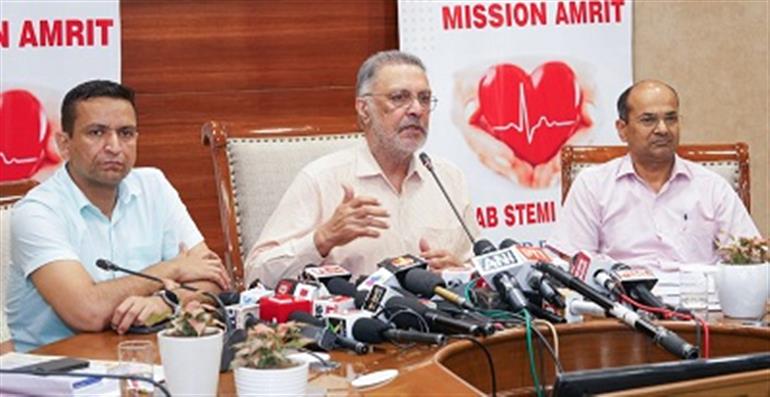
To mark National Doctors’ Day, Punjab Health and Family Welfare Minister Balbir Singh inaugurated the statewide rollout of the Punjab STEMI Project, enabling district and sub-divisional hospitals across all 23 districts to promptly administer thrombolytic treatment using the clot-dissolving drug Tenecteplase to heart attack patients.
This significant initiative, named “Mission Amrit” (Acute Myocardial Reperfusion In Time), is designed to significantly enhance survival chances for patients experiencing ST-segment Elevated Myocardial Infarction (STEMI)—a critical and life-threatening form of heart attack.
Joined by Principal Secretary Health Kumar Rahul and renowned cardiologist Dr. Bishav Mohan from DMCH Ludhiana, Dr. Balbir Singh explained that under this project, the Tenecteplase injection, which typically costs ₹30,000, is being provided free of charge. This medication plays a vital role in dissolving heart-related blood clots.
Following the success of a pilot project initially introduced in Ludhiana and Patiala and later extended to nine additional districts, the initiative is now being implemented statewide. In the pilot phase, over 14,000 patients with chest pain were evaluated, and of the 1,305 STEMI patients identified, 583 received timely thrombolysis at government hospitals—significantly improving survival rates.
Dr. Singh emphasized that in the past, Punjab’s heart attack patients often experienced delays of 2–3 hours before reaching medical facilities. Many local centers lacked proper diagnostic tools, causing treatment delays and missing the critical Golden Hour, the optimal window for life-saving thrombolysis.
To address these challenges, the project uses an innovative Hub and Spoke model. District and sub-divisional hospitals act as Spokes—handling diagnosis and initial treatment—while six expert Hub hospitals, including DMCH Ludhiana, GMCH-32 Chandigarh, and the Government Medical Colleges in Patiala, Faridkot, Amritsar, and AIIMS Bathinda, provide tele-ECG consultations and advanced care.
Under this model, patients arriving at a Spoke hospital receive immediate treatment under real-time expert guidance from Hub hospitals. They are given free Tenecteplase (TNK 40 mg) injections, and once stabilized, are referred to the Hub for further management.
Calling the launch a landmark moment for Punjab’s healthcare system, Dr. Balbir Singh highlighted that the STEMI Project, building on the ICMR pilot in Mohali and Ludhiana, reflects the government’s dedication to providing timely and equitable cardiac care across the state. He stressed that by decentralizing life-saving treatment, the initiative is bridging critical gaps and improving survival odds for heart attack patients, especially in rural and remote areas.
To ensure effective implementation, more than 700 medical professionals, including specialists, EMOs, and nurses from all districts, have been trained at DMCH Ludhiana under Dr. Bishav Mohan’s supervision. Emergency rooms have been fully equipped with ECG machines and defibrillators to manage STEMI cases.
Dr. Bishav Mohan emphasized public awareness, noting that many individuals often confuse heart attack symptoms with gastric issues. He pointed out that ischemic heart disease remains the leading cause of death in India, and timely, accurate treatment can save countless lives.
During the event, 12 doctors from across the state were honored for successfully administering thrombolysis within the crucial window period.
Several dignitaries, including State Information Commissioner Adv. Harpreet Sandhu, NHM MD Ghanshyam Thori, PHSC MD Amit Talwar, and senior officials from the Health Department, medical colleges, and AIIMS, were also present.
ST-elevation myocardial infarction (STEMI) is a severe heart attack caused by a blockage in a coronary artery, cutting off blood supply to part of the heart muscle. Prompt treatment is critical to restore blood flow and reduce permanent damage or fatal complications.
The STEMI Project uses a Hub-and-Spoke framework to connect local hospitals with tertiary centers, enabling rapid diagnosis, expert guidance via tele-ECG, immediate administration of free clot-busting therapy, and timely referral for specialized care.