
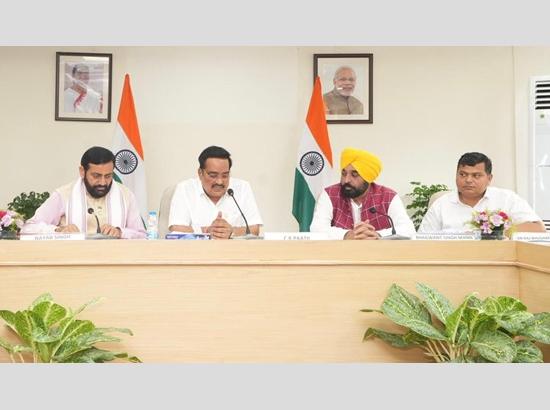
Punjab CM Bhagwant Singh Mann urged the Government of India to utilize Chenab river water to resolve the long-standing water dispute between Punjab and Haryana, thereby setting aside the Satluj Yamuna Link (SYL) canal issue.
Participating in a meeting convened by Union Jal Shakti Minister C.R. Patil on the SYL matter, CM Bhagwant recalled that in the July 9 meeting, the Centre had informed that the Indus Water Treaty with Pakistan has been suspended. He said this creates a major opportunity for India to tap Chenab river water—earlier allocated to Pakistan—and store it in Indian reservoirs like Ranjit Sagar, Pong, or Bhakra. For transporting this additional water, he suggested building new canals and infrastructure in Punjab, which could first meet the state’s needs, with surplus supply going to Haryana and Rajasthan.
CM Bhagwant stressed that using Chenab water would cut Punjab’s dependence on depleting groundwater, revive surface irrigation, and strengthen agriculture while preserving water for future generations. He asserted that Punjab should be given priority in any plan for allocation of western rivers and proposed constructing new upstream storage dams in Himachal Pradesh to enhance water regulation.
Rejecting the need for the SYL canal, CM Bhagwant proposed alternatives such as the Sharda Yamuna Link to transfer surplus Sharda water to the Yamuna and divert Chenab water to the Beas via the Rohtang tunnel. This, he said, would fulfill Haryana’s share from Ravi-Beas waters, meet Delhi’s growing drinking water needs, and benefit Rajasthan. He also pressed for Punjab’s inclusion as a partner state in the post-2025 review of the 1994 Yamuna water-sharing MoU, seeking 60% of surplus Yamuna waters for Punjab.
CM Bhagwant argued that Haryana has other unaccounted water sources, including 2.703 MAF from local rivers and nalas, which should be considered before allocations. Warning of serious law-and-order implications, he reiterated that SYL is an “emotive issue” and that Punjab lacks available land for it. He pointed out that Punjab gets only 40% (14.22 MAF) of the total 34.34 MAF from its rivers, while non-riparian states—Haryana, Delhi, and Rajasthan—receive the rest. This, coupled with reduced surface water, has driven over-exploitation of groundwater in 75% of Punjab’s blocks, the highest in India.
CM Bhagwant highlighted Punjab’s major contribution to national food security—47% of India’s wheat procurement in 2024 and 24% of rice—despite having only 26.75 MAF water against its requirement of 52 MAF. Meanwhile, floods from Punjab’s rivers damage the state annually while benefits are shared among partner states, warranting compensation.
CM Bhagwant urged that water-sharing agreements and tribunal decisions be reviewed every 25 years in line with international norms and evolving environmental realities. He said Punjab’s claim to Yamuna waters is as valid as Haryana’s claim to Ravi-Beas, citing the 1972 Irrigation Commission Report. He also reminded that Punjab had already terminated the 1981 Ravi-Beas agreement through the 2004 Punjab Termination of Agreements Act.