
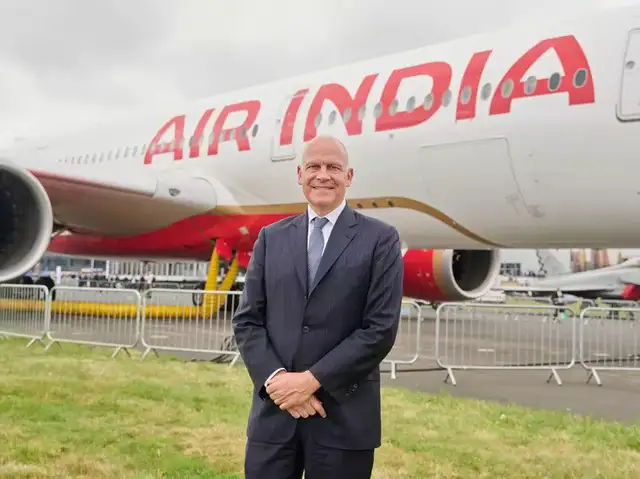
Campbell Wilson’s Air India faces operational and financial turbulence; fleet delays, regulatory shocks, and competition challenge the ambitious turnaround plan.
When Campbell Wilson took the reins of Air India in July 2022, expectations were sky-high. With the Tata Group assuming management control earlier that year and placing a historic order of 470 aircraft in February 2023, the former Singapore Airlines executive was tasked with orchestrating one of aviation’s most ambitious transformations.
Nearly four years into his tenure, Campbell Wilson faces a challenging landscape of structural weaknesses, operational delays, and external shocks that have left Air India grappling for stability. Reports from the Economic Times suggest that Tata Sons Chairman N. Chandrasekaran may be considering a successor for Campbell Wilson before his term officially ends in 2027, highlighting the urgency of the airline’s situation.
Singapore Airlines Feels the Strain
Air India’s turbulence has particularly impacted Singapore Airlines (SIA), its most significant global partner. In November 2022, SIA merged Vistara with Air India, committing nearly S$1 billion for a 25.1% stake in the enlarged group, including Air India Express. The move was intended as a long-term strategic investment, giving SIA access to India’s rapidly growing aviation market while enabling operational synergies.
also read:- Gold Price Today: Gold and Silver Drop at the Start of…
However, the returns have yet to materialize. SIA reported a record 68% drop in profits in the six months ending September 2025, with Air India’s losses as a major contributor. Air India’s consolidated losses surged 48% in FY25 to ₹10,859 crore, underscoring the depth of financial and operational challenges under Campbell Wilson.
FY26: External Shocks Compound Challenges
The first half of FY26 brought further turbulence. Airspace closures in Pakistan following Operation Sindoor in May 2025 forced route suspensions, affecting long-haul efficiency. Compounding this, the June 12, 2025, Air India crash prompted mandatory DGCA inspections, grounding aircraft and disrupting international operations. Aviation experts note that these uncontrollable events have strained the airline’s finances, limiting Campbell Wilson’s ability to stabilize the carrier.
Loss of India’s International Leadership
One of the most symbolic setbacks for Air India under Campbell Wilson has been losing its status as India’s largest international carrier. Low-cost rival IndiGo flew 4.13 million international passengers in the September quarter, edging past Air India’s 4.09 million. While narrow, this shift underscores deeper structural issues, from unscheduled aircraft groundings to limited fleet availability. For an airline historically dominant in India’s international skies, the loss marks a strategic turning point.
Fleet Delays Hamper Ambitions
Air India’s revival hinged on fleet expansion. Of the 570-aircraft order, 524 are yet to be delivered, forcing the airline to retrofit 17 aging planes as a stopgap. This adds operational complexity and costs. Under the Vihaan.AI transformation plan, Air India aimed to lift domestic market share to 30%. Progress has been modest, rising from 25.9% in October 2022 to just 26.7% in November 2025, while IndiGo surged from 56.3% to 64.4%.
Operational Lapses and Reputation Risk
Persistent operational lapses exacerbate the challenge. In November, Air India operated a flight without proper safety certification due to procedural oversights, inviting regulatory scrutiny. Passenger complaints about delays, broken seats, and non-functional entertainment systems further strain the airline’s image. Despite Campbell Wilson’s focus on process and culture reform, such issues erode confidence in the turnaround narrative.
A Turnaround Still Uncertain
Wilson’s tenure reflects scale, ambition, and historic investment, but execution has been hampered by fleet delays, regulatory shocks, operational lapses, and competition. The financial strain on Singapore Airlines demonstrates that Air India’s struggles carry international implications.
As the airline charts its next phase, the path ahead is critical. For Campbell Wilson—or his potential successor—the challenge is not just restoring Air India’s balance sheet but proving that the airline can deliver on its long-promised potential in one of the world’s most competitive aviation markets.
For More Hindi News: http://newz24india.com