
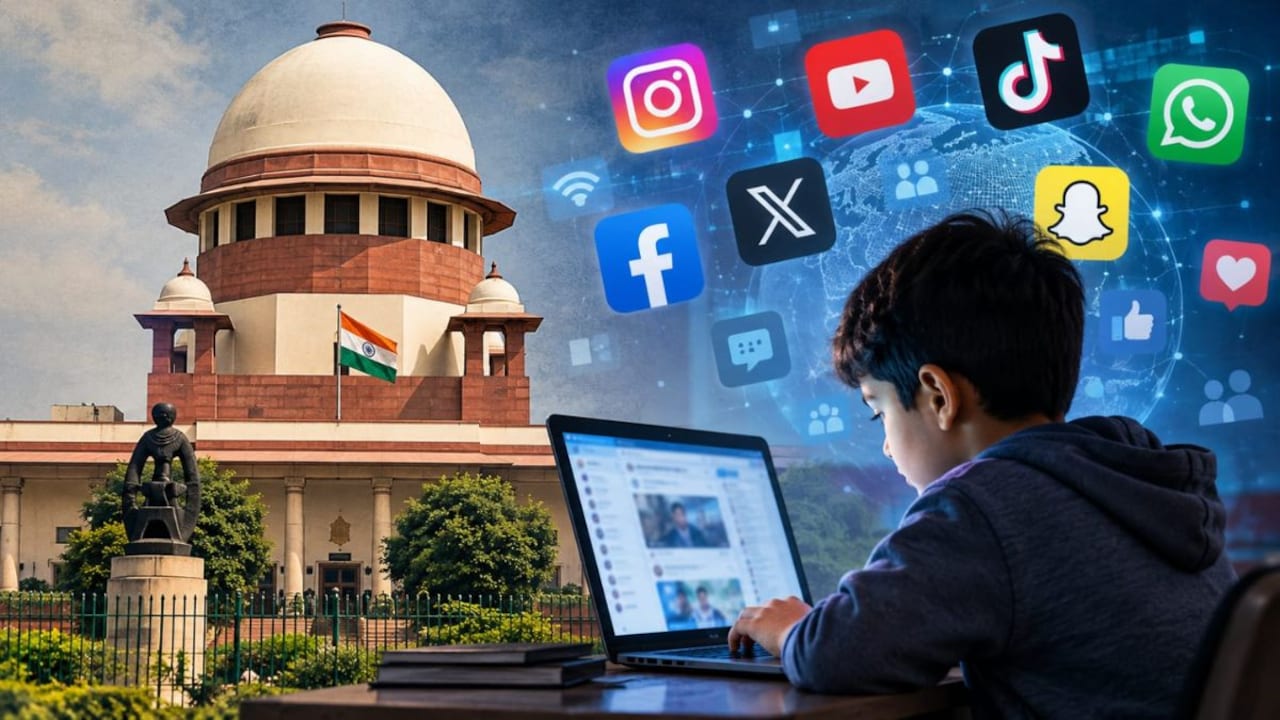
The Supreme Court recognises children’s internet access as a fundamental right, calls for age-appropriate online safeguards and stronger action against harmful content.
The Supreme Court of India has emphasised that children cannot be completely excluded from the digital world in the name of online safety, recognising the importance of internet access in their education, expression and personal development. The court observed that protecting children from online threats must go hand in hand with safeguarding their fundamental rights.
The observations came from a bench comprising Justice J.B. Pardiwala and Justice K. Vinod Chandran while hearing a petition concerning child sexual exploitation material on social media and other online platforms. The court also called for stronger measures to identify and remove such harmful content.
The ruling highlights the need to balance children’s digital rights with effective safeguards against online abuse. The Supreme Court’s observations on internet access as a fundamental right for children underline that a blanket prohibition is not necessarily the right way to address the risks associated with internet use.
Supreme Court Links Internet Access to Fundamental Rights
The bench recognised the constitutional importance of internet access in the context of Articles 21 and 19(1)(a). Article 21 protects the right to life and personal liberty, while Article 19(1)(a) guarantees freedom of speech and expression.
The court observed that completely keeping children away from the internet would not eliminate the dangers they encounter online. Instead, the risks should be addressed through effective regulation, platform accountability and safeguards appropriate to children’s ages.
According to the bench’s observations, excessive restrictions could also create unintended problems. Children might turn to unregulated platforms or find alternative ways to access online services, potentially exposing themselves to even greater risks.
The court further highlighted the importance of creating an environment in which children feel comfortable reporting online threats, exploitation and abuse to their parents or other trusted adults.
also read:- Amit Shah To Visit Kolkata Durga Puja Pandals During…
Why Internet Access Matters for Children
The internet has become an important source of education, information, communication and creative expression. For many children, digital platforms provide opportunities that may not be readily available in their immediate surroundings.
Children living in remote areas, for instance, may depend on online resources for educational material, learning opportunities and access to information. Digital connectivity can also help children with special needs communicate with others who share similar experiences.
The court’s observations recognise that internet access as a fundamental right for children is connected to more than entertainment or social media use. It can also support learning, inclusion and participation in society.
The bench referred to earlier judicial decisions, including the Supreme Court’s 2020 ruling in Anuradha Bhasin and its 2025 judgment in Pragya Prasun, in discussing principles related to freedom of expression and digital access.
Supreme Court Suggests Age-Appropriate Online Safeguards
While highlighting the importance of children’s digital rights, the bench also stressed the need to protect young users from harmful online interactions and inappropriate content.
The court suggested several measures that could help make internet use safer for children. These included:
Parental consent and supervision: Children’s social media accounts could require parental involvement, depending on their age.
Private accounts by default: Platforms could automatically set children’s accounts to private to limit unsolicited contact from strangers.
Age-appropriate content controls: Measures could be introduced to restrict children’s exposure to harmful advertisements and unsuitable material.
Dedicated child mode: Online platforms could offer a separate mode designed specifically for younger users, with stronger privacy and safety settings.
These measures were presented as suggestions rather than a final, universally applicable set of rules. The bench left it to the Central Government to consider how appropriate safeguards could be implemented.
The court also acknowledged that reasonable restrictions may be necessary to protect children from harmful material and services, including adult content.
Court Calls for Stronger Action Against Child Sexual Abuse Content
Alongside its observations on children’s internet rights, the Supreme Court stressed the need for more effective action against online material involving child sexual exploitation and abuse.
The directions seek to strengthen the identification and removal of such content from social media platforms and other online services. The court also called for the development of a national database to help identify objectionable material and facilitate its removal.
The broader objective is to ensure that children are protected from exploitation without unnecessarily denying them access to useful digital resources.
Online platforms play an important role in this process because harmful material can spread rapidly across services. Stronger identification systems, reporting mechanisms and removal procedures can help address these risks more effectively.
Online Safety and Children’s Freedom Must Go Together
The Supreme Court’s observations highlight a central challenge for policymakers: protecting children from digital threats without excluding them from the benefits of the internet.
A blanket ban may appear to offer a straightforward solution, but it could also limit access to educational resources, communication tools and opportunities for social inclusion. At the same time, unrestricted internet use without suitable safeguards can expose young users to exploitation, harmful content and unwanted contact.
By emphasising internet access as a fundamental right for children, the court has drawn attention to the importance of a balanced approach that combines digital access with age-appropriate protections and greater accountability from online platforms.
The next steps will depend on how the Central Government considers the suggested safeguards and strengthens existing mechanisms against child sexual exploitation material. The larger objective remains clear: children should be able to benefit from the digital world while receiving meaningful protection from its dangers.
For More Hindi News: http://newz24india.com