
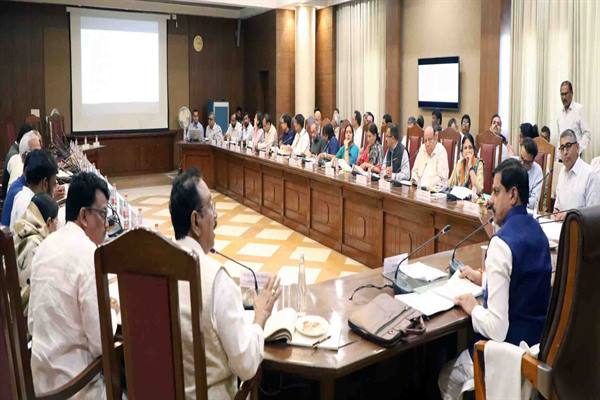
CM Mohan Yadav has stated that maximum efforts will be made for the welfare of tribal communities in the state. The state government is also committed to preserving tribal culture. Essential facilities for worship will be provided at religious sites of tribal communities in forest areas. Necessary instructions have been issued to the Forest Department for this. In the Pradhan Mantri Jan-Man Yojana, eligible beneficiaries from particularly vulnerable tribal groups who have not yet received benefits will be identified through necessary verification and surveys. Under the Dharati Aba Tribal Village Utkarsh Abhiyan, all tasks will be completed within the stipulated time. Special coaching under the Aakanksha Scheme will be provided to tribal students. The scheme will be expanded to offer both offline and online coaching for recruitment into government services and admissions into prestigious educational institutions. Chief Minister Dr. Yadav chaired a meeting of the Madhya Pradesh Tribal Advisory Council on Monday.
The meeting was held in the Assembly Committee Room and attended by Tribal Affairs Minister Dr. Kunwar Vijay Shah, Scheduled Caste Welfare Minister Shri Nagar Singh Chauhan, Public Health Engineering Minister Smt. Sampatia Uikey, legislators, council members, Additional Chief Secretary to the Chief Minister Dr. Rajesh Rajoura, Additional Chief Secretary of the Forest Department Shri Ashok Barnwal, Additional Chief Secretary of Home Shri J.N. Kansotia, Principal Secretary of Tribal Development Shri Gulshan Bamra, and other senior officials.
No Effort Will Be Spared in Tribal Welfare
CM Mohan Yadav emphasized that every possible step will be taken for the welfare of the tribal communities in the state. In Dhar district, an initiative has been undertaken to include three-fourths of the tribal population in a battalion. Similar efforts will be made in the eastern regions of the state, including Mandla, Dindori, and other districts. The government will take all necessary measures for the development of tribal communities based on regional circumstances.
Promotion of Tribal Culture and Participation in Fairs
CM Mohan Yadav stated that tribal artists from the state will be sent to participate in major fairs. Last year, representatives from various tribal-dominated districts participated in the processions of Baba Mahakal in Ujjain. Tribal artists will continue to be involved in various events. The Bhagoria festival, a prominent cultural festival in the western region of the state, holds great significance. The government will provide full encouragement to the tribal communities associated with this festival, and a decision has been made to officially celebrate Bhagoria at the government level.
Full Respect for Tribal Warriors
CM Mohan Yadav noted that the government has taken significant steps to honour tribal warriors. A cabinet meeting was held at Singrampur, the first capital of Rani Durgavati. Additionally, a battalion of the Special Armed Forces (SAF) has been named after Rani Durgavati, and a university in Sagar has been named after Veerangana Avantibai Lodhi. The Krantisurya Tantya Mama University has been established in Khargone. Soon, a commemorative event will be organized in honour of Gond King Bhabhoot Singh, a respected figure in the tribal community. Efforts are also underway to educate the new generation about these tribal heroes. The Vanya Radio initiative is being utilized for the promotion and preservation of tribal culture.
Cultural Preservation Centers to Be Strengthened
CM Mohan Yadav has directed that special efforts be made to preserve tribal culture. Religious leaders of tribal communities, including Tadvi, Patel, and Bhumka, will be engaged in these efforts. Under the Cultural Conservation Research and Development Scheme, seminars, workshops, and Aadi Rang programs are being conducted. Cultural preservation centres such as the Baiga Culture Center in Mandla, the Bharia Culture Center in Tamia, the Sahariya Culture Center in Sheopur-Kuno, the Bhil Culture Center in Mandu, and the Raja Shankar Shah Museum in Jabalpur are being made more active. The Chief Minister also instructed that the Tribal Advisory Council meetings be held regularly and that members conduct periodic separate meetings with senior officials.
Madhya Pradesh Leading in Various Welfare Schemes
Madhya Pradesh is at the forefront of implementing various welfare schemes for the tribal population. Under the PM Jan-Man Yojana, the state has achieved 100% success in providing Kisan Credit Cards and opening Jan Dhan Bank Accounts for the tribal community. The state has also attained a 99% achievement rate in issuing caste certificates, preparing Aadhaar cards, and implementing the PM Kisan Samman Nidhi scheme.
To achieve the goal of road connectivity in all villages, work is being completed in 24 districts by June 2025. The Pradhan Mantri Awas Yojana has benefited the tribal community by providing permanent housing. More than 7.5 lakh families have received tap water connections under the Har Ghar Nal Se Jal scheme. The Energy Department has provided electricity connections to 13,800 households.
Construction of Anganwadi centres is ongoing, with 355 new approved centres currently under development in tribal areas. Under the Telecom Services Expansion, 18 new towers have been activated, and all 43 planned towers will be operational soon. In 21 districts covering 87 tribal development blocks, 66 mobile medical units are operational under the PM Jan-Man Yojana.
Under the Dharati Aba Tribal Village Utkarsh Abhiyan, various departments are implementing welfare schemes in tribal regions. A total of 25 schemes from 18 departments and ministries have been identified for execution, leading to significant improvements in the socio-economic conditions of tribal families.
During the meeting, updates were provided on the implementation of the Forest Rights Act 2006, the conversion of forest villages into revenue villages, and the execution of the PESA Act 2022 in scheduled areas. The government has established human resource and training programs for PESA implementation.
Information was also shared regarding new Gram Sabhas, Peace and Dispute Resolution Committees, Village Sabha Funds, Forest Resource Planning and Control Committees, Sahogini Matri Committees, Land Management, Minor Mineral Surveying and Excavation, Control over Narcotics, and Regulation of Moneylending Practices under the PESA Act. The council members were also briefed on the department-wise actions taken based on the suggestions provided in the previous meeting.