
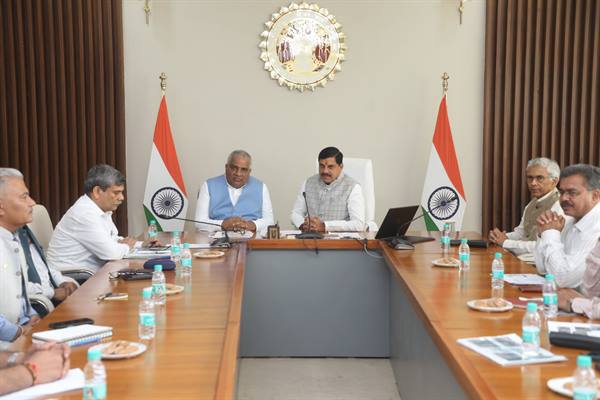
CM Mohan Yadav announced that Madhya Pradesh is undertaking extensive efforts to develop its ecosystem. Wildlife tourism boosts the economy and serves as a gateway to prosperity. The state government is committed to developing Kuno National Park as a model wildlife tourism destination. Alongside Kuno, Gandhi Sagar Sanctuary in Mandsaur district will soon host cheetahs. With Central Government support, two cheetahs from Kuno will be relocated under high security to Gandhi Sagar Sanctuary on April 20.
CM Mohan Yadav revealed plans to enhance tourism at Kuno National Park by improving direct road and air connectivity from Gwalior. He was addressing a review meeting at Samatva Bhavan (the Chief Minister’s residence) on the Cheetah Project’s implementation in Madhya Pradesh, attended by Union Minister for Environment, Forest and Climate Change, Bhupender Yadav.
CM Mohan Yadav was pleased to note that cheetah cubs born in Madhya Pradesh have the world’s highest survival rate. In contrast, cubs in other countries often struggle to adapt to local climates. Gandhi Sagar Sanctuary offers an ideal environment for cheetahs, prompting the state to introduce them there to enrich the sanctuary.
CM Mohan Yadav announced plans to develop a paved, all-season road from Gwalior to Kuno National Park and establish a tent city within the forest for tourists. Following Union Minister Bhupender Yadav’s vision, an international-level veterinary hospital and rescue center will be set up in the Kuno area with central assistance. This facility will serve cheetahs and support cattle care across the region.
The state will tap into nature tourism’s potential and involve more youth and women in wildlife tourism. Women from Self-Help Groups and Cheetah Mitras (‘Cheetah Friends,’ local volunteers supporting cheetah conservation) will be trained as tourist guides. ‘Didi Cafés’ (women-run cafes under the State Livelihood Mission) will be opened in the Kuno area, creating local employment opportunities for women.
CM Yadav noted that the reintroduction of cheetahs has ended a century-long wait. The state is also working to conserve king cobras, gharials, and rare turtles. In the first phase, ten king cobras will be introduced to Madhya Pradesh to balance the population of venomous snakes in the state’s forests. He instructed forest officials to relocate gharials and turtles from the Chambal River to four major rivers and reservoirs across the state.
Union Minister Bhupender Yadav praised CM Mohan Yadav’s efforts in promoting wildlife conservation and tourism. He recommended forming a Task Force of senior officials from the Forest, Tourism, Animal Husbandry, Panchayat & Rural Development, Tribal Affairs, and Transport Departments to monitor wildlife rehabilitation projects. To train the 400 Cheetah Mitras from 80 villages in Sheopur district, he proposed an agreement with the Indian Institute of Forest Management (IIFM), Bhopal. These volunteers will also be trained in homestay management and nature tourism roles.
Historical sites near Kuno should be developed for tourism. An old fort could be transformed into a heritage walk destination, and viewpoints for watching crocodiles and gharials, wildlife rescue centers, and Ayurvedic wellness centers should be established. Union Minister Yadav emphasized involving women from Self-Help Groups to provide tourist facilities at Kuno and other wildlife destinations. High-quality accommodation, food, and sanitation services are essential to attract domestic and international visitors. With world-class facilities, Kuno National Park and Gandhi Sagar Sanctuary could draw global tourists eager to see cheetahs.
According to the National Tiger Conservation Authority (NTCA), over ₹112 crore has been spent on the Cheetah Project, with 67% invested in Madhya Pradesh. Cheetahs will now be translocated to Gandhi Sagar Sanctuary in phases. As the sanctuary borders Rajasthan, both states have agreed to form an Inter-State Cheetah Conservation Complex. Additional cheetahs are expected from South Africa, Botswana, and Kenya. In two phases, eight cheetahs will arrive from Botswana—four by May 2025 and four later. Negotiations for an agreement with Kenya are underway.
Forest officials reported that Kuno National Park currently has 26 cheetahs, with 16 in the wild and 10 in rehabilitation enclosures. Female cheetahs Jwala, Asha, Gamini, and Veera have given birth to cubs. All cheetahs are tracked 24/7 via satellite-collar IDs. Since the cheetahs’ introduction, tourist footfall in Kuno has doubled over two years. The state government has sought Supreme Court approval to launch a Cheetah Safari, as safaris in forests or eco-sensitive zones require judicial permission.
The meeting was attended by Shri Tanmay Kumar, Secretary, Ministry of Environment, Forest and Climate Change; Shri Anurag Jain, Chief Secretary, Madhya Pradesh; Shri Sushil Kumar Awasthi, Director General of Forests and Special Secretary; Dr. Govind Sagar Bhardwaj, Additional Director General, Project Tiger & Member Secretary, NTCA; Shri S.P. Yadav, Interim Director General, International Big Cat Alliance (IBCA); Shri Sanjayan Kumar, Additional DG, NTCA; Shri Vaibhav C. Mathur, Deputy DG, NTCA; Shri Anjan Kumar Mohanty, Deputy DG (Wildlife), MoEFCC; Shri Ashok Barnwal, Additional Chief Secretary, Forest; Shri Aseem Srivastava, Principal Chief Conservator of Forests; Shri Shubhranjan Sen, Chief Wildlife Warden and PCCF (Wildlife); Shri L. Krishnamurthy, Additional PCCF (Wildlife); Shri Atul Kumar Mishra, Secretary, Forest; Dr. Sudam Khade, Secretary and Commissioner, Public Relations; and other senior officials.