

Elon Musk Joins the Conversation on Netflix’s Adolescence and Its Criticism
Elon Musk recently reacted to a claim about Netflix’s series Adolescence after an X user accused the show of promoting “anti-white propaganda.” The post, shared by Ian Miles Cheong (@stillgray), claimed that the show was based on real-life incidents like the Southport murder. The accusation suggested that the series had “race-swapped” the actual killer—who was allegedly a black man or migrant—into a white boy and framed the character as being radicalized by the “red pill” movement, often associated with certain online communities. Cheong referred to it as an example of “anti-white propaganda.” To which Elon Musk responded with a simple “Wow.”
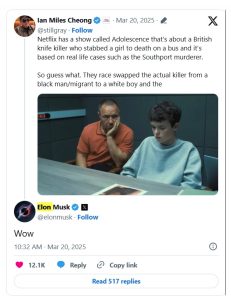
Elon Musk’s simple “Wow” caught people’s attention and got the conversation going. His reaction seemed to highlight the bigger conversation about how race and storytelling are handled in TV shows.
Adolescence: The Truth Behind the Claims
Another user quickly replied to Cheong’s post, clarifying that the claims were untrue. According to this reply, Adolescence is not based on the Southport case or any real-life event but instead addresses the broader issue of knife crime in the UK. The response pointed out that these claims had been debunked multiple times, emphasizing that the series was not a direct retelling of any specific incident, but rather an exploration of the societal impact of knife crime.
This explanation pushed back against the narrative that the show was linked to any one event or used race as a focal point in its storytelling.
Jack Thorne Addresses the Accusations
Co-writer of Adolescence, Jack Thorne, also responded to the allegations. In a podcast discussion, Thorne clarified that the series was not based on a true story and that the decision to feature a white boy in the lead role wasn’t intended to make any statement about race. He explained that the focus of the show was on masculinity and the challenges faced by boys, rather than on issues of racial representation.
Thorne explained that the show aimed to dive deep into the problem of masculinity and how young boys navigate the pressures of society. We’re not trying to make a statement about race, he clarified. “We are making a point about masculinity.”
His comments reinforced the idea that the series was more about the psychological and social struggles of boys, not about making a statement on racial dynamics.
The Ongoing Discussion Around Representation
The situation surrounding Adolescence touches on broader debates about race and representation in media. As discussions about diversity and inclusion continue to grow in importance, many shows are increasingly being evaluated through the lens of their character choices and how they engage with sensitive social issues.
In this case, Adolescence is being scrutinized for its handling of both race and violence. The series, despite its intention to focus on masculinity and societal problems, finds itself in the middle of a much larger conversation about how race is portrayed on screen.