
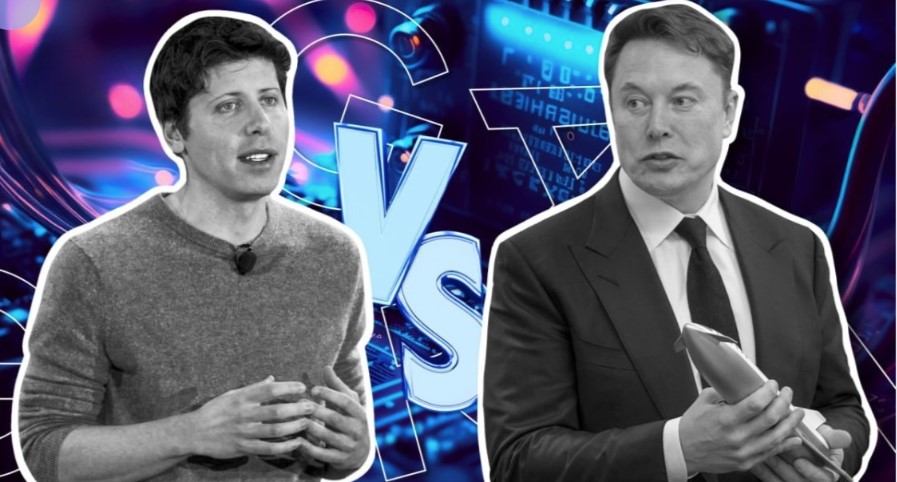
Sam Altman and Elon Musk’s Public Showdown: What’s Really at Stake for AI?
The battle between Elon Musk and Sam Altman has turned into one of the most riveting tech feuds in recent memory, drawing attention from Silicon Valley and beyond. What started as a collaboration between two visionaries has spiraled into a legal drama that continues to unfold. Their fight is about more than just business—it’s about the future of artificial intelligence and the values behind its development.
The story begins in 2015 when Elon Musk and Sam Altman co-founded OpenAI with a noble goal: to ensure artificial intelligence benefited humanity. Their shared vision was to create AI that was open-source, transparent, and focused on societal good, standing in opposition to tech giants like Google. But as with many partnerships, things didn’t last. By 2018, Elon Musk stepped away from OpenAI after a reported power struggle, especially over Elon Musk’s proposal to merge OpenAI with his other company, Tesla—a suggestion that was rejected by Sam Altman and the board. Altman took over as CEO, and from there, their paths diverged.
For years, Elon Musk and Sam Altman kept quiet about their split. But it seems the tension was always simmering beneath the surface. In 2024, Elon Musk took the first major step in reigniting the conflict by filing a lawsuit against Altman, Greg Brockman (OpenAI’s president), and even Microsoft. Elon Musk accused them of betraying OpenAI’s original mission of openness and non-profit ideals, arguing that the company had evolved into a commercial enterprise with a focus on profits over people.
The Elon Musk’s lawsuit is OpenAI’s release of GPT-4, the advanced AI model that has become the talk of the town. Elon Musk argues that by charging for access to GPT-4 and locking it behind paywalls, OpenAI is straying from its original principles. He claims that the company has now become a for-profit entity, with Microsoft pulling the strings, something he sees as a direct contradiction to OpenAI’s founding ethos.
This conflict reached a turning point in May 2025 when Sam made a major announcement: OpenAI would remain under the control of its non-profit parent organization. In response to Musk’s lawsuit and public criticism, Sam Altman walked back plans to restructure OpenAI into a Public Benefit Corporation (PBC), which would have loosened restrictions and allowed for more corporate control. Instead, Sam Altman reassured the public that while OpenAI’s for-profit arm would undergo restructuring to raise capital, the non-profit organization would retain control over the company. It was a significant move, one that seemed to appease Elon Musk’s concerns, but the legal battle wasn’t over yet.
For More: Harsh Pokharna: IITian Struggles with Bengaluru Rent Despite Raising ₹120 Crore in Funding