
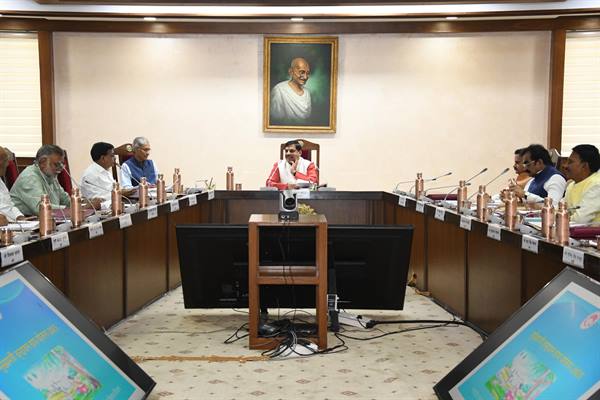
Madhya Pradesh NEWS : The Madhya Pradesh Cabinet has approved the ‘Mukhyamantri Vrindavan Gram Yojana’, an ambitious initiative to promote self-sufficiency in rural areas. Under this scheme, one village from each assembly constituency—having a population of at least 2,000 and a minimum of 500 cattle—will be selected and developed as a Vrindavan Gram. These model villages will serve as benchmarks for comprehensive rural development and self-reliance.
The scheme’s primary focus areas include cow rearing and dairy development, organic farming, environmental conservation, water management, promotion of solar energy, pasture development, infrastructure enhancement, rural entrepreneurship, and employment generation. The vision is to integrate spiritual, ecological, and economic sustainability, realizing the essence of “Vrindavan” in Madhya Pradesh’s countryside. Key goals include expanding cooperative-based dairy enterprises, boosting eco-friendly practices like organic farming and solar use, enhancing infrastructure, and achieving Sustainable Development Goals (SDGs) through community participation.
Facilities and Infrastructure to be Developed Across 6 Categories
The scheme will involve a comprehensive infrastructure rollout in selected villages, including:
-
Community & Civic Infrastructure: Gaushalas, anganwadis, health centers, schools, libraries, skill/livelihood centers, community halls, cremation grounds (Shantidham), solar street lights, and e-panchayat/CSC services.
-
Utilities & Sanitation: Piped solar-powered water supply to every household, drainage systems, individual and public toilets, and waste segregation units.
-
Agriculture & Allied Services: Milk collection centers, pasture development, biogas plants, artificial insemination centers, irrigation systems including drip irrigation, and small agri/forest-based industries.
-
Water Management: Rainwater harvesting, roof-top water collection, tube well and dug well recharge, check dams, and pond restoration.
-
Heritage, Tourism & Culture: Conservation of religious sites, establishment of handicraft centers, and promotion of rural tourism including home-stays.
-
Digital & Governance Initiatives: Land record digitization, 100% e-KYC of households, and planning support for village spatial development.
Additional employment-oriented components such as Nandan Falodyan, Poshan Vatika, and skill-based service promotion will also be introduced to uplift rural livelihoods.
Cabinet Approvals on Key State Initiatives
-
₹4,572 Crore Sanctioned for Rebuilding Damaged Bridges
The Cabinet approved an in-principle fund of ₹4,572 crore for reconstructing 1,766 damaged bridges between 2025–26 and 2029–30. The Madhya Pradesh Rural Road Development Authority will supervise the project to ensure all-weather connectivity. -
Rashtriya Raksha University Campus in Bhopal
The Cabinet cleared the proposal to establish a campus of the Rashtriya Raksha University (RRU), Gandhinagar, in Bhopal. ₹1.05 crore per year for three years has been approved. Ten acres within the RGPV campus have been allocated, with temporary use of existing infrastructure until the new campus is built. This move aims to boost national security education and collaboration. -
Hostel Mess Services for Backward Class Welfare Department
Approval was granted to initiate mess services in 108 departmental hostels housing 9,050 students. The total sanctioned amount is ₹31 crore, including ₹14 crore as one-time capital and ₹17 crore for recurring costs. -
1,266 New Posts for Criminal Justice Reforms
To facilitate the enforcement of new criminal laws, the Cabinet approved 1,266 new positions, including 202 scientific officers in forensic labs. This aligns with the Bharatiya Nagarik Suraksha Sanhita, 2023, which mandates forensic experts in serious crimes. Madhya Pradesh has become the first state to implement this rule. -
Creation of Tribal and SC Coordinators’ Offices in New Districts
Offices for District Tribal and Scheduled Caste Coordinators will be set up in the newly created districts of Mauganj, Maihar, and Pandhurna. A total of 48 posts have been sanctioned, with an annual budgetary impact of ₹3.81 crore.