
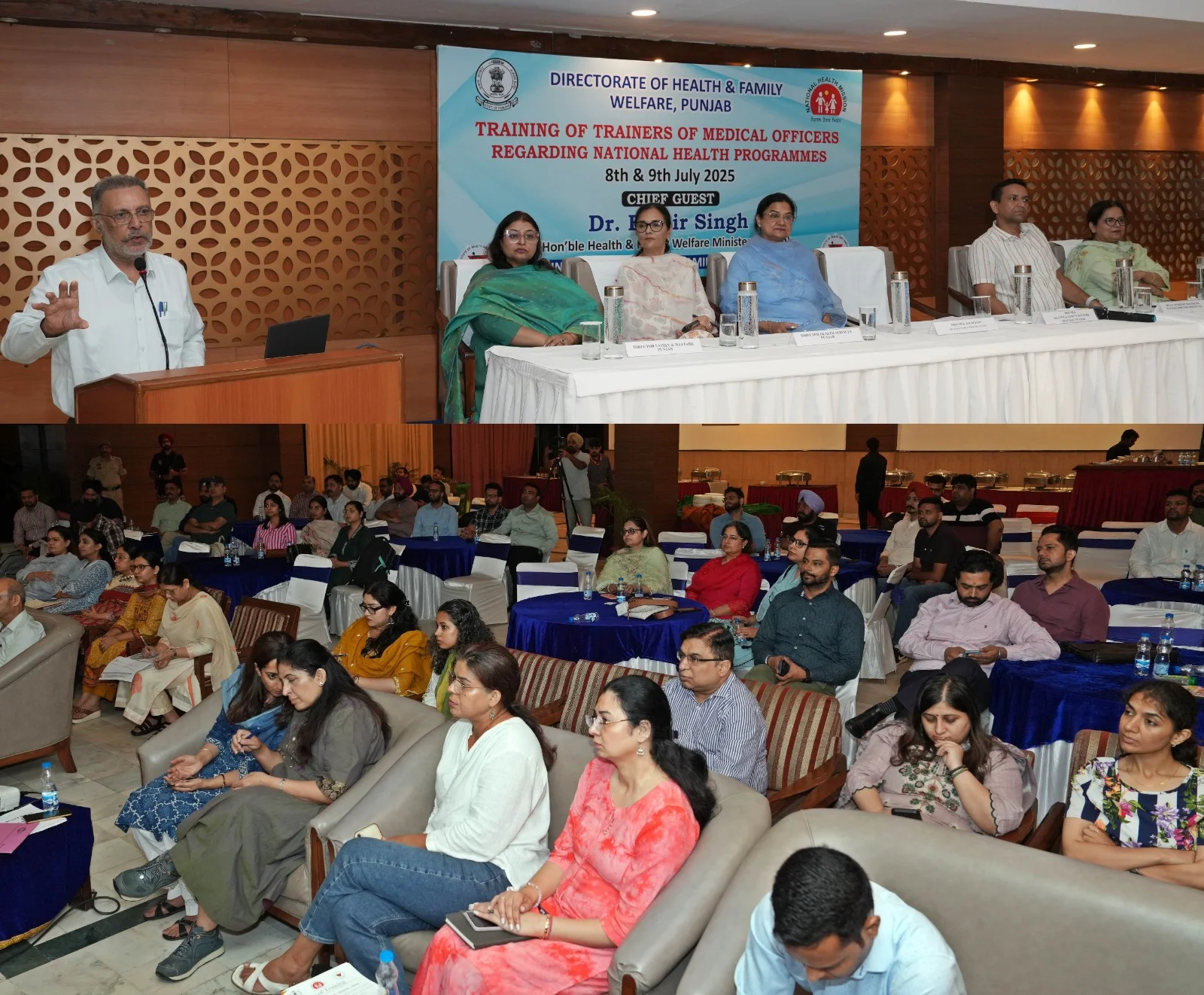
In a major step to strengthen emergency healthcare infrastructure, Punjab Health and Family Welfare Minister Balbir Singh on Wednesday unveiled a comprehensive plan to train at least two Medical Officers (MOs) in each district in advanced critical care at leading medical institutions. The goal is to equip doctors with the necessary expertise to handle ICU and trauma situations efficiently across the state.
Addressing the closing session of a two-day ‘Training of Trainers’ (ToT) workshop on National Health Programs and MLR/PMR for Medical Officers, Minister Balbir highlighted that this initiative will significantly enhance the state’s capacity to respond during the vital “golden hour”—the critical period immediately after a medical emergency when prompt care can be lifesaving.
“Every moment is crucial in an emergency. Punjab is committed to setting new standards in golden-hour response to ensure no patient is left without timely care,” he stated, referencing the success of the STEMI project, which has notably reduced heart attack-related fatalities through prompt intervention.
Medical professionals from all 23 districts took part in the training, underlining Punjab’s focus on delivering accessible, high-quality, and inclusive healthcare services.
Describing doctors as the pillars of the healthcare system, Minister Balbir said their commitment and proficiency will be the foundation of a healthier Punjab. “Our mission extends beyond treating illnesses—we aim to build a preventive, responsive, and compassionate healthcare ecosystem,” he added.
Highlighting the importance of empathetic care for psychiatric patients and individuals recovering from addiction, the minister said that under Chief Minister Bhagwant Mann’s leadership, the government is merging skill development with medical care to aid rehabilitation and reintegration. “Mental health remains a top priority. We are committed not only to treatment but also to empowering patients through rehabilitation,” he affirmed.
Minister Balbir further announced that Punjab will recruit 1,000 new Medical Officers, who will undergo rigorous induction training before being posted in rural, border, and underserved regions, thereby narrowing the gap between urban and rural healthcare.
To further boost the system’s capabilities, he noted that Senior Medical Officers are being sent to IIM Ahmedabad for specialized emergency training, while psychiatrists have completed mental health programs at AIIMS Delhi to embed psychological services within primary care.
The minister also revealed plans to introduce state-level awards to honor exceptional service in medicine and public health, alongside strengthening disease surveillance through newly formed State Working Groups and District Coordination Committees.
Reaffirming the government’s pledge to achieve Universal Health Coverage, Minister Balbir emphasized retaining medical specialists in the public sector and ensuring access to essential medicines at no cost.
In his closing remarks, Minister Balbir lauded healthcare professionals, referring to them as “the chosen architects of Punjab’s medical future,” and reiterated the government’s commitment to innovative, equitable, and top-tier healthcare services for all citizens.
The event was also attended by Special Secretary Health-cum-MD NHM Ghanshyam Thori, Director Health and Family Welfare Dr. Hitinder Kaur, Director Family Welfare Dr. Jasminder, Deputy Directors Dr. Navjot Kaur and Dr. Surinderpal Kaur, Principal SIHFW Dr. Pommy Chatrath, and Dr. Amandeep Kaur Warring.