
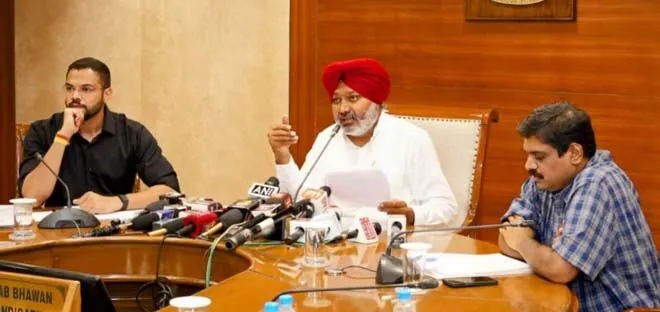
Minister Harpal : Punjab has achieved an unprecedented 44.44% surge in Net GST collections for June 2025 and a significant 27.01% increase for the first quarter of the 2025–26 fiscal year. This marks the highest-ever GST revenue growth for both a single month and a fiscal quarter in the state’s history.
This announcement was made by Punjab’s Finance, Planning, Excise, and Taxation Minister Harpal Singh Cheema, during a press conference. The Minister honored the state’s top five taxpayers for their notable contributions to economic growth and revenue, including Ashu Agnihotri (Ambuja Cement), Sanjay Malhotra (HPCL-Mittal Energy), Chaman Lal Sharma (Samsung India), Ankush Sharma (Tata Steel), and Nitin Dada (Dada Motors). Cheema praised their commitment and stressed the importance of responsible tax compliance in driving inclusive growth and fiscal strength.
Joined by Secretary Taxation Ajit Balaji Joshi and Excise and Taxation Commissioner Jitendra Jorwal, Cheema emphasized that Punjab has surpassed the national GST growth rate, positioning itself among the top states in revenue mobilization—despite national and geopolitical hurdles like border tensions.
In June 2025, Net GST collections reached ₹2,379.90 crore, up by ₹732.21 crore compared to ₹1,647.69 crore in June 2024. The state also posted 15.35% growth in April and 24.59% in May. In Q1 of FY 2025–26, the total GST collection stood at ₹6,830.40 crore, a notable rise from ₹5,377.75 crore in Q1 of 2024–25, despite the May 2025 India-Pakistan conflict. This 27.01% growth rate is over four times the 6.41% increase recorded during the same period last year.
Cheema also criticized the previous SAD-BJP and Congress governments for failing to curb tax evasion and improve the state’s financial situation. He credited the Bhagwant Singh Mann-led AAP government for ensuring consistent growth, noting GST growth rates of 16.25% in FY 2022–23, 15.51% in FY 2023–24, and 12.84% in FY 2024–25. The AAP government collected ₹62,733 crore over three years—more than what the Congress regime collected in five (₹55,146 crore). In comparison, the SAD-BJP era saw only 4.57% and 2.67% growth in VAT and CST for FY 2014–15 and 2015–16, respectively.
He also noted that the previous Congress government relied heavily on compensation grants totaling ₹30,070 crore without a long-term revenue strategy. In contrast, the current government focused on enforcement, data-driven inspections, and compliance to curb evasion and stabilize finances.
Cheema revealed recent enforcement actions, including the busting of a major GST fraud racket by SIPU involving 20 fake firms set up by an accountant, leading to fraudulent transactions of ₹866.67 crore and estimated tax evasion of ₹157.22 crore. Another case involved M/s Maa Durga Roadlines in Chandigarh, which issued fake e-way bills and moved unaccounted goods worth ₹168 crore, evading taxes worth ₹30.66 crore.
Responding to questions, Cheema said Punjab will need to pay ₹25,000 crore in interest and ₹18,200 crore in principal on past debt in FY 2025–26. Despite ₹13,000 crore in deductions by the Centre, the state plans to borrow ₹49,900 crore this fiscal, including ₹8,500 crore in Q2 to meet legacy debt redemption of over ₹3,500 crore.
Concluding, Cheema asserted that Punjab’s finances are on a firm footing. He pointed out that the state has recently invested ₹1,000 crore each in the Guarantee Redemption Fund and the Consolidated Sinking Fund, which now stands at over ₹10,000 crore—up from just ₹3,000 crore when the AAP government took charge.