
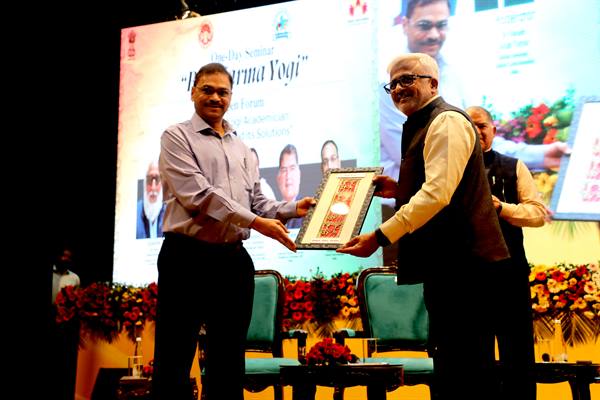
MP NEWS : The workshop “Be a Karmayogi,” organized under the guidance of Governor Shri Mangubhai Patel, became a confluence of challenges and solutions in the education system, akin to the Maha Kumbh that unites spiritual and worldly welfare. This unprecedented initiative facilitated dialogue among Vice Chancellors, Registrars, Principals, PM Excellence awardees, and educationists from 78 government and private universities across the state, focusing on the Karmayogi education system. In the closing ceremony, Additional Chief Secretary to the Governor, Shri KC Gupta, honoured the educationists with mementoes.
Emphasis on reflective education instead of repetitive education – Prof. R. Balasubramaniam
As the first speaker of the technical session, Prof. R. Balasubramaniam, a member of the Human Resource Capacity Building Commission and Mission Karmayogi, Government of India, shared his insights on ‘Transforming Challenges into Opportunities: A Karmayogi’s Approach to Inspiring Educational Leadership.’ He emphasized that universities and educational institutions should prioritize student welfare and interests, ensuring policies and regulations are designed and implemented accordingly. Prof. Balasubramaniam highlighted the need to develop the capabilities of students in alignment with future demands. Instead of repetitive learning, he advocated for reflective education, encouraging the use of competitive and collaborative techniques to enhance students’ personalities. He stressed that both teachers and students should align their preparation with evolving expectations and make effective use of technology for impactful teaching. Keeping pace with technological advancements is essential for educators. Prof. Balasubramaniam further stated that universities must focus on producing leaders to contribute to India’s development. Shifting from a business-oriented mindset to an academic-driven approach is crucial. He also underscored the importance of selecting teachers based on subject specialization and integrating them as knowledge partners within institutions.
The university will have to develop the research eco-system – Prof. K. Radhakrishnan
Prof. K. Radhakrishnan, Chairman of the Board of Governors, IIT Kanpur, delivered a speech on “Indian Education Policy: Steps to Transform Work into Worship.” He emphasized that education is the most powerful tool for transforming individuals and society. To achieve this, universities must focus on developing a robust research ecosystem, as knowledge is refined and expanded through continuous research. During the session, Prof. Radhakrishnan also explored the significance of India’s historical knowledge and traditions in the context of the new Education Policy of India. He shared insightful anecdotes from his extensive career as a space scientist, highlighting the practical relevance and inspiration of the Karmayoga principle in academic and professional life.
Even machine knowledge cannot replace human knowledge – Prof. Santishree Dhulipurdi Pandit
Jawaharlal Nehru University Delhi Vice Chancellor, Prof. Santishree Dhulipudi Pandit, spoke on ‘Principles of Karmayoga in Transformational Educational Leadership.’ She emphasized that teachers must continuously update their conduct, personality, and knowledge to align with changing scenarios and student needs. Education should go beyond academics to instill practical values such as humility, truth, discipline, and hard work in students. Prof. Dhulipudi highlighted that despite advancements in information technology and artificial intelligence, machine knowledge can never replace human wisdom. Therefore, teachers must remain lifelong learners, setting an example for students by demonstrating a commitment to reading, writing, and critical thinking. Through insights from her extensive academic and administrative career, she shared successful experiences underscoring the significance of Karmayoga in education.
Gita is a great book for personal and spiritual upliftment – Dr. Vikrant Singh Tomar
Dr. Vikrant Singh Tomar, Global Convenor of United Consciousness, shared his insights on ‘Indian Education: From Employee to Karmayogi.’ He delved into the profound messages of Karmayoga as outlined in the Bhagavad Gita, emphasizing its significance as a guiding text for both personal and spiritual upliftment. Dr. Tomar explained practical methods for self-development based on the Gita’s teachings, offering valuable perspectives on transforming from an employee into a Karmayogi in administrative and professional life. He provided insightful lessons on applying Karmayoga principles to cultivate a purpose-driven approach to work and life.
In the workshop, a voting process was conducted on 450 challenges and solutions gathered from the reflections of over 11 thousand 700 teachers and students regarding the key challenges and solutions for fostering a dedicated academic culture. Among the 11 major challenges identified, key issues included: Lack of enthusiasm for attendance and engagement among students, emphasis on quality over quantity in research and pressures of non-academic responsibilities and excessive teaching loads. Expert scholars of the session, along with Prof. Anil Sahasrabuddhe, who participated online, engaged with workshop participants to guide them on addressing these challenges and implementing effective solutions.
Universities should prepare leadership for a strong nation – Commissioner Shri Warvade
Commissioner of Higher Education, Shri Nishant Warvade, praised the workshop’s initiative as a commendable step towards nation-building. He informed the participants that the workshop’s deliberations had been recorded and assured that the Higher Education Department would provide the necessary support, both directly and indirectly. He emphasized that universities serve as the foundation for leadership development across all sectors, contributing to the strength of the nation. To fulfill this role effectively, education leaders must embrace Karmayoga and become Karmayogis themselves. Shri Warvade highlighted that Karmayoga is the most effective approach to unlocking students’ potential. Expressing hope, he stated that the insights from the workshop would serve as a guiding framework for the nation’s education system. Under Secretary, Raj Bhavan, Smt. Abha Shukla, concluded the session by extending a vote of thanks.