
MP NEWS : Chief Executive Officer of the Madhya Pradesh State NITI Aayog, Shri Rishi Garg, stated that sustainable development is not solely the government’s responsibility — it requires the active participation of the private sector, civil society and the general public. Sharing the outline of the state’s vision document ‘Developed Madhya Pradesh @2047’, he explained how the government’s strategy is aligned with the Sustainable Development Goals (SDGs). He was addressing the one-day workshop on ‘Private Sector Engagement in Accelerating SDG Implementation in Madhya Pradesh’, held in Bhopal on Thursday. The workshop was jointly organised by the Madhya Pradesh State NITI Aayog and GIZ India, under the Indo-German Green and Sustainable Development Partnership (GSDP). The goal of the workshop was to localise and fast-track SDG implementation, ensure active private sector involvement and align state development plans with international cooperation.
Ms. Henrike Peichert, Project Head of GIZ India, provided detailed insights into Indo-German cooperation, highlighting GIZ’s support in planning, capacity building, engagement, and monitoring. UNDP Resident Representative Ms. Angela Lusigi, speaking during the inaugural session, expressed concern over the global SDG progress, noting that only 12% of the goals are currently on track. However, she praised India, and particularly Madhya Pradesh, for remarkable progress in poverty eradication, clean energy, and water security. Ms. Harshika Singh, CEO of the Madhya Pradesh State Rural Livelihoods Mission (MPSRLM), shared innovative schemes like ‘Lakhpati Didi’, which open new avenues for private-sector collaboration, especially in climate-resilient agriculture, waste management, and carbon credit initiatives.
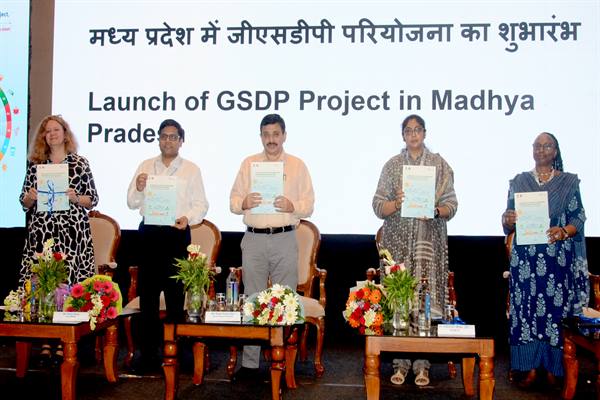
The formal launch of the Indo-German GSDP Project also took place during the event. Shri Rajib Kumar Sen, Senior Adviser, NITI Aayog, gave a detailed presentation on the SDG India Index, the Multidimensional Poverty Index (MDPI), and the National Indicator Framework.
During a state-focused session, Shri Rishi Garg shared that under the state has identified 22 major missions and over 300 action points, of which more than 200 goals are achievable within the next five years. He also highlighted that 22,519 gram panchayats across the state have been trained on nine key development themes.
In the technical session, Prof. Manish Goyal from IIT Indore presented a study on land degradation and drought risk using NDVI (Normalised Difference Vegetation Index).
Dr. Ashish Desai from ‘SP Jain’, Mumbai, speaking on ‘Profit to Purpose’, emphasised the role of the private sector and appreciated initiatives like HUL’s Shakti Amma program, ESG investments, and the ‘Vasudhaiva Kutumbakam’ ethos.
Principal Architect Shri Diwakar Kishor suggested that a combination of digital technologies, data, and diversity could potentially help achieve 70% of the SDG targets. Participants asked in-depth questions on land degradation, private investment, science and CSR funding during the Q&A session, which were answered by Shri Garg in alignment with the state’s commitments.
Ms. Henrike Peichert moderated a panel discussion featuring experts from Odisha, the Indo-German Chamber of Commerce, UNDP, and the SP Jain Institute of Management and Research. The discussion explored practical ideas on financial innovation, public-private partnerships, green skilling, and risk mitigation.
In the final session titled “Best Practices and Experiences”, representatives from Meghalaya, Himachal Pradesh, and Odisha shared challenges and innovations related to localising SDGs in their states. Ms. Anna Lotta Nagel from the German Council for Sustainable Development shared her insights on local-level sustainability reporting.
The workshop served as a significant step towards localising SDGs in Madhya Pradesh, enhancing private sector engagement, and integrating international cooperation into the state’s development framework. Delegates from various states and organizations shared their experiences, offering practical lessons and solutions.