
President Droupadi Murmu urges Keralam to lead evidence-based Panchakarma research, strengthen Ayurveda studies and document traditional knowledge.
President Droupadi Murmu has called on Keralam to strengthen its traditional Ayurvedic knowledge and emerge as a global leader in evidence-based Panchakarma research. Addressing the golden jubilee celebrations of Vaidyaratnam Ayurveda College in Thrissur on Friday, the President said the state has a rich heritage of classical Ayurvedic learning and a valuable tradition of medical knowledge preserved by generations of Vaidya families.
Murmu emphasised that Keralam has the potential to become an international reference point for authentic and scientifically evaluated Panchakarma treatments. She urged Ayurvedic colleges, government institutions and private organisations to work together to advance research and establish a stronger scientific foundation for traditional medicine.
The President said Keralam’s contribution to Ayurveda extends beyond its international reputation, as the state has continuously nurtured classical learning, traditional medicine preparation and the transmission of medical knowledge across generations.
President Calls for Scientific Evaluation of Panchakarma
Referring to a recent study on the Ayush service sector, President Droupadi Murmu said Keralam could play a leading role in establishing globally recognised standards for authentic Panchakarma practices.
She stressed that evidence-based Panchakarma research should become a priority for the state’s Ayurvedic institutions.
According to the President, colleges and research organisations should collaborate to evaluate traditional treatments through scientific methods. Such efforts could help strengthen the credibility of Ayurveda and expand its contribution to contemporary healthcare.
Panchakarma is a group of traditional Ayurvedic procedures associated with cleansing and rejuvenation. President Droupadi Murmu’s remarks highlighted the importance of examining these practices through systematic research and scientific evaluation.
Keralam’s Rich Ayurvedic Heritage Recognised
The President praised Keralam for preserving a distinctive tradition of classical Ayurvedic education and medicine.
She said the state’s Vaidya families had enriched medical knowledge through generations of practice, teaching and the preparation of traditional medicines.
Murmu also highlighted the contribution of the Ashtavaidyas, traditional Ayurvedic physicians who developed expertise not only in medical practice but also in scholarship and education.
She noted that classical Ayurvedic literature in Keralam was not confined to Sanskrit. Important original works and commentaries were also produced in Malayalam and Manipravalam, a language that emerged in medieval Keralam and was used in several manuscripts.
The President said these literary traditions demonstrated the depth of the state’s contribution to Ayurveda and its continued preservation of traditional medical knowledge.
Documentation of Traditional Medical Knowledge Is a National Priority
President Droupadi Murmucalled for systematic documentation of classical texts, manuscripts, treatment methods and practical knowledge preserved by traditional Ayurvedic families.
She said the Ashtavaidya families had maintained a rich legacy of studying and practising the teachings of Ashtanga Hridayam and other classical Ayurvedic texts.
The President also referred to traditional knowledge in Agada Tantra, Kaumarabhritya and Marma Chikitsa, along with the use of medicinal plants by different communities.
She described the preservation and documentation of these practices as a task of national importance.
According to Murmu, recording this knowledge systematically would help future generations understand and study India’s traditional medical heritage.
Government Initiatives to Strengthen Traditional Medicine
The President highlighted several initiatives aimed at providing a modern scientific foundation for India’s traditional systems of medicine.
She referred to the Ministry of Ayush’s ‘One Herb, One Standard’ programme and research projects undertaken by its specialised councils.
Murmu also mentioned the WHO Global Traditional Medicine Centre in Jamnagar, Gujarat, which is working to develop a global knowledge hub for traditional medicine through science, data and technology.
She encouraged Ayurvedic colleges in Keralam to undertake collaborative research projects with government institutions and reputed international organisations.
The President said such partnerships could support evidence-based Panchakarma research and help strengthen the scientific understanding of traditional medical practices.
also read:- Health Ministry Observes Constitution Day 2026 With…
Ayurvedic Colleges Must Serve Communities
President Droupadi Murmu said Ayurvedic colleges should focus on providing authentic and effective treatment while contributing to the development of contemporary Ayurvedic education.
She emphasised that institutions must prepare capable Vaidyas and researchers who can respond to the healthcare challenges faced by present and future generations.
The President Droupadi Murmu also said that Ayurvedic institutions, including Vaidyaratnam Ayurveda College, were contributing to India’s goal of becoming a healthy and developed nation by 2047.
She added that greater collaboration among Ayurvedic colleges across Keralam could help accelerate progress towards this national objective.
President ‘s Message to Ayurveda Students
Addressing students at the event, Murmu encouraged them to preserve the tradition of combining professional practice with service to society.
She said traditional knowledge-based enterprises and service to underprivileged communities should continue to progress together.
The President urged students to remember their responsibility towards society as they enter their professional lives.
She also appreciated Vaidyaratnam Ayurveda College for maintaining quality education and professional standards over five decades while adapting to emerging challenges.
President Visits Temples in Keralam
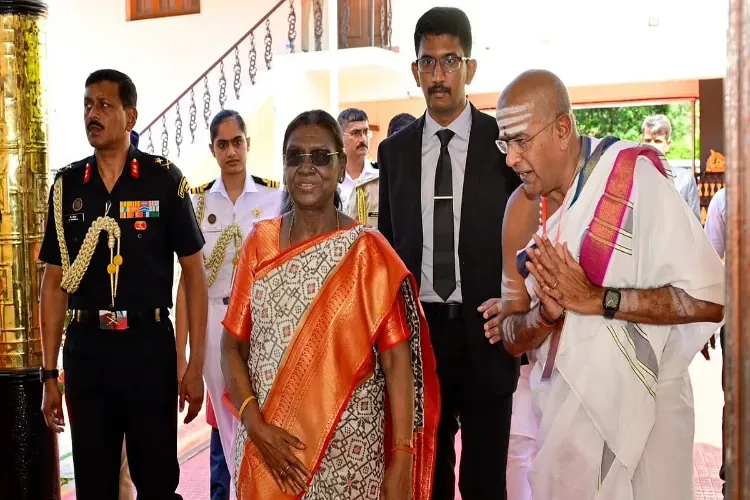
Earlier in the day, Murmu visited the Sri Adi Shankara Janmabhoomi temple at Kalady, the birthplace of Adi Shankaracharya.
She reached the temple by road from Cochin International Airport at 11.04 am. Governor Om Prakash Mathur, Sringeri Mutt CEO and administrator P A Murali, and Minister Roji M John received her.
The President was welcomed with a traditional Purna Kumbha ceremony before entering the temple. She completed her visit and left for the airport at 11.13 am.
Following the programme in Thrissur, Murmu travelled to Guruvayur to visit the Sree Krishna Temple.
Governor Om Prakash Mathur, Union Minister Suresh Gopi, and state Ministers K Muraleedharan and Roji M John were among those present at the golden jubilee celebrations.
The President’s address underscored Keralam’s potential to combine its traditional Ayurvedic heritage with modern scientific research, while encouraging institutions to preserve medical knowledge and expand its contribution to healthcare.
For More Hindi News: http://newz24india.com