
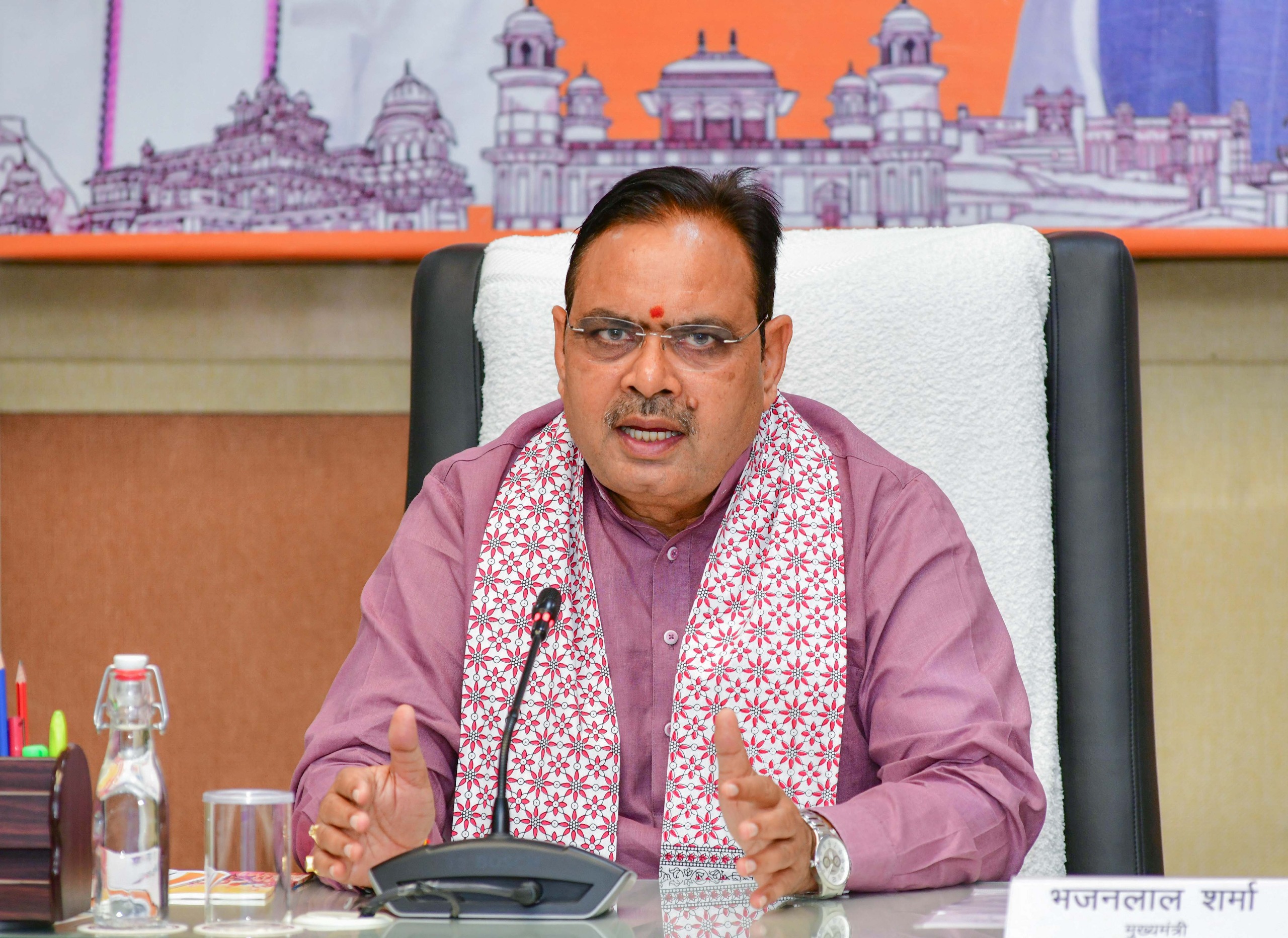
The ‘Vande Ganga’ Water Conservation-Jan Abhiyan, an initiative of CM Bhajan Lal Sharma, has set new records in the field of water conservation and harvesting. This campaign, carried out with immense public support, has brought unprecedented improvement in the direction and condition of water sources across the state. With a detailed plan of action and wide impact, this campaign has emerged as a source of inspiration from the environmental point of view, which will see positive results in the coming times.
In Rajasthan, the largest state in the country, availability of water has been the biggest challenge due to adverse geographical conditions. Due to uneven distribution of rainfall during monsoon and low availability of surface water, Rajasthan has been largely dependent on traditional water sources and resources. In order to achieve the goal of conservation and conservation of these water sources, CM Bhajan Lal Sharma launched the Vande Ganga Jal Sanrakshan – Jan Abhiyan (June 5-20). The most important aspect of this campaign is that it has been kept people-centric so that its impact is widespread. At the same time, the worship of water sources has been made a major activity of this campaign so that the public feels inclined and connected to water culture.
The Chief Minister visited various parts of the district.
CM Bhajan Lal Sharma launched the campaign on the auspicious occasion of Ganga Dussehra and World Environment Day (5th June). On the first day of the campaign, he performed Shramdaan at Ramgarh Dam in Jaipur, offered chunri to Chambal Maa at Keshoraypatan in Bundi and lit a lamp at Sujanganga canal in Bharatpur. On this day, the members of the Council of Ministers also participated in various activities related to water conservation under the campaign across the state. During the campaign, the Chief Minister personally visited different areas of the state and participated in it and continuously monitored. He paid obeisance to Tirtharaj Pushkar at Brahma Ghat in Pushkar on 9th June and performed Jalabhishek on the sails of Jawaja Talab in Beawar. Thereafter, on 18th June, the Chief Minister performed Jheel Aarti at Nauchowki Pal at Jheel in Rajsamand. He also reached Seelu Ghat in Jalore where he offered prayers to Maa Narmada. On 20th June, Chief Minister Shri Bhajan Lal Sharma concluded the campaign by performing Ganga Aarti and worshipping the ancient Gadisar Lake in Jaisalmer.
More than 3 lakh 70 thousand programs have been organised
With the inspiration of CM Bhajan Lal Sharma, this campaign turned into a movement. Lakhs of people came out of their homes and actively participated in water conservation works. As on 20th June, more than 3 lakh 70 thousand programmes have been organised under the Abhiyaan in which about 2 crore 53 lakh citizens including 1.32 crore women participated. Along with more than 42,200 water sources, more than 73,900 offices, hospitals and schools have also been cleaned. In this campaign, about 18,900 completed works were reviewed and about 5,900 new works have also been launched. Along with this, the common people also performed Shramdaan at more than 1 lakh 2 thousand places under water conservation activities.
During the campaign, 13,600 gramme sabhas, 6,800 prabhat pheris, 9,800 kalash yatras, 6 thousand different types of chaupals were organised to spread the message of water conservation and saving water sources and to create public awareness. During this time, 3,200 recharge shafts were also constructed in the Mathrubhumi campaign from Karmabhoomi with the help of CSR and donors.
The campaign gained momentum through collective efforts and mutual coordination
Under this campaign, work was done under a special action plan towards water conservation and harvesting. A large number of people, including officials of various departments, non-governmental organisations, industrial groups and industrialists, participated in the campaign. With collective efforts and mutual coordination, cleaning of rivers, nullahs, water sources, construction of water harvesting structures and rejuvenation of traditional water bodies like stepwells, ponds, wells etc. took place on a large scale. During this time, extensive work was also done in connection with Mukhyamantri Jal Swavlamban, Hariyalo Rajasthan and Karmabhoomi se Mathrubhumi Abhiyan. These works will have a positive impact in the future and the ground water level of the state is also expected to increase.
Adequate water supply from villages to towns is the topmost priority of the State Government
Under the guidance of the successful Prime Minister Shri Narendra Modi and the leadership of CM Bhajan Lal Sharma, the state government has taken historic decisions and made unprecedented plans to make Rajasthan water-rich in the tenure of about one and a half years. The Ramjal Setu Link Project (Modified Parvati-Kalisindh-Chambal Project) will provide water for drinking and irrigation to 17 districts of the state. Similarly, the Yamuna Water Agreement for the Shekhawati region is being materialised. The state government is working to strengthen the Indira Gandhi Canal Project so that Ganganagar, Hanumangarh to Barmer, Jalore get ample water. Similarly, work is being done on the Dewas project to ensure water availability in the districts of southern Rajasthan. These schemes show that the state government is working with full commitment to ensure water supply from villages to towns of the state. Adequate water supply to the people is the topmost priority of the State Government.