
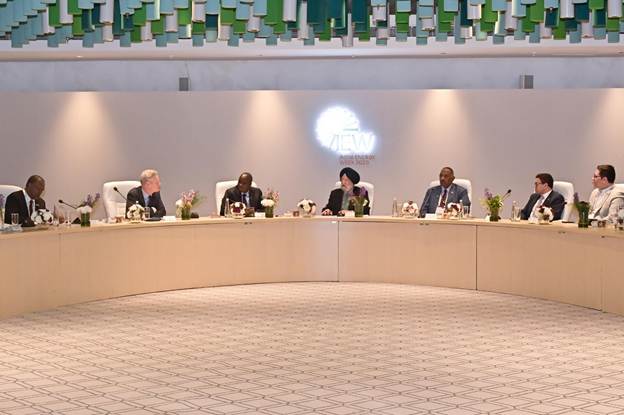
India Energy Week 2025 : Union Minister of Petroleum and Natural Gas, Shri Hardeep Singh Puri, led a Ministerial Roundtable on Clean Cooking during the second day of India Energy Week 2025. He emphasized India’s significant achievements in providing universal access to clean cooking gas, attributing the success to targeted subsidies, decisive political commitment, digitalization of distribution networks by Oil Marketing Companies (OMCs), and extensive nationwide campaigns encouraging a cultural shift toward clean cooking practices.
The session convened representatives from Brazil, Tanzania, Malawi, Sudan, Nepal, and key industry stakeholders, including the International Energy Agency (IEA), Total Energy, and Boston Consulting Group (BCG).
Shri Hardeep Singh Puri highlighted that India’s clean cooking model is not only highly effective but also adaptable for other Global South nations facing similar energy access challenges. He emphasized that under the Pradhan Mantri Ujjwala Yojana (PMUY), beneficiaries can access LPG at an exceptionally low cost of just 7 cents per day, while other consumers can avail of clean cooking fuel at 15 cents per day, making affordability a key driver of widespread adoption.
During the discussion, international delegates shared their experiences in expanding clean cooking solutions. Tanzania’s Deputy Prime Minister and Minister of Energy, Hon. Dkt. Doto Mashaka Biteko, outlined the country’s goal of transitioning 80% of households to clean cooking by 2030 through subsidies and a diversified energy mix, including LPG, natural gas, and biogas. However, he acknowledged major obstacles such as financing constraints, high infrastructure costs, and regulatory challenges that limit private-sector participation.
H.E. Dr. Mohieldien Naiem Mohamed Saied, Sudan’s Minister of Energy and Oil, emphasized the critical role of the private sector in addressing gaps in LPG supply, as the nation continues to rely on imports for a significant share of its energy needs. He highlighted the need for local cylinder production and cost-effective import strategies to facilitate greater adoption. Additionally, representatives from Rwanda and Nepal shared their initiatives to reduce dependence on firewood by expanding the use of electric stoves and biogas.
Mary Burce Warlick, Deputy Executive Director of the IEA, emphasized that India’s success offers valuable insights for other countries, particularly in overcoming affordability and infrastructure challenges. She stressed the importance of concessional financing and public-private partnerships (PPP) in accelerating access to clean cooking solutions globally. She also highlighted the need for regulatory adjustments, such as tax reductions, to encourage large-scale adoption.
Rahool Panandiker, Partner at Boston Consulting Group (BCG), praised India’s clean cooking transformation, attributing its success to strong political will, well-targeted subsidies, and effective public awareness campaigns. He commended the role of India’s Oil Marketing Companies (OMCs) in enabling seamless last-mile LPG delivery through digital platforms. Additionally, he noted the importance of refining the cylinder refill model to maintain affordability while ensuring long-term economic sustainability.
Addressing the potential of solar cookers in expanding clean cooking technologies across the Global South, Shri Puri highlighted Indian Oil Corporation Limited’s (IOCL) advanced solar cookers, which integrate solar panels and are priced at approximately $500 per unit with no recurring costs. While acknowledging the current price challenge, he suggested that leveraging carbon financing and private-sector collaboration could help lower costs, making solar cooking more accessible to millions.
This initiative aligns with India’s broader strategy to diversify clean cooking options beyond LPG, reinforcing the country’s commitment to reducing reliance on traditional biomass fuels and cutting carbon emissions.
In concluding remarks, Shri Puri reaffirmed India’s dedication to supporting global energy access initiatives. He emphasized that India’s model, driven by smart subsidies and sustainable policies, provides a scalable solution for other developing nations striving for universal clean cooking access. He underscored that ensuring access to clean cooking is not just an economic priority but also a moral obligation, given the severe health and environmental consequences of biomass-based cooking.
The roundtable reinforced India’s leadership in the global energy transition and clean cooking solutions, setting the stage for enhanced international collaboration in achieving universal access to clean energy.
About India Energy Week 2025
India Energy Week was conceived as more than just an industry conference—it serves as a dynamic platform shaping global energy discussions. In just two years, this self-funded initiative has become the world’s second-largest energy event. The third edition, scheduled from February 11-14, 2025, at Yashobhoomi, New Delhi, marks another significant milestone in influencing the global energy landscape.