
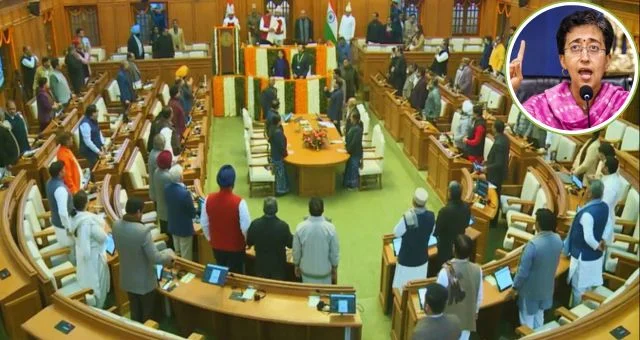
AAP Disrupts Delhi Assembly Over Pollution, BJP Slams Atishi for Skipping Session
The Delhi Assembly witnessed intense political turmoil on the fifth day of the Winter Session as the Aam Aadmi Party (AAP) staged a protest over air pollution, triggering sharp reactions from the Bharatiya Janata Party (BJP). The confrontation unfolded inside and outside the Assembly premises, once again highlighting the growing political friction around governance and environmental accountability in the national capital.
AAP Protests Over Pollution and Governance Issues
As discussions on Delhi’s worsening air quality began, AAP legislators raised slogans and disrupted proceedings. The party alleged that the ruling administration was deliberately diverting attention from urgent civic issues such as contaminated water supply, deteriorating law and order, the condition of the Yamuna river, and rising pollution-related health risks.
AAP MLA Sanjeev Jha claimed that the focus was being shifted through misleading narratives rather than constructive debate. According to him, the opposition was demanding immediate withdrawal of what they described as a fabricated video and disciplinary action against legislators accused of spreading misinformation. The party insisted that accountability was necessary to protect the integrity of legislative discussions.
BJP Accuses AAP of Avoiding Accountability
The BJP responded strongly, accusing AAP leaders of evading meaningful debate. Delhi Minister Manjinder Singh Sirsa said the opposition avoided the Assembly as soon as discussions on pollution were initiated. He questioned the absence of Opposition Leader Atishi, suggesting it reflected a lack of seriousness toward Delhi’s governance challenges.
Sirsa further stated that after more than a decade in power, AAP leaders were unwilling to face questions related to their administrative record. He alleged that repeated walkouts and disruptions were tactics to avoid public scrutiny and responsibility.
Ministers Highlight Past Conduct in the House
Delhi Minister Ashish Sood also criticized AAP’s conduct in recent sessions, pointing out that earlier debates were disrupted with inappropriate remarks. He said that despite being vocal about pollution earlier, the party refrained from discussion when asked to explain policy outcomes. Sood added that public accountability cannot be avoided through continuous disruptions and political theatrics.
also read:- Delhi Assembly Disrupted During Debate on Guru Tegh…
Extended Session and Budget Concerns
Another senior minister, Parvesh Verma, emphasized that the Winter Session had already been extended to ensure the passage of revised budget estimates. He warned that delays could directly impact development projects across Delhi. Verma alleged that AAP was intentionally stalling legislative work to create political narratives rather than supporting governance processes.
He also reiterated criticism of Atishi’s absence from the House, calling for disciplinary action instead of an apology. According to him, elected representatives must participate in discussions that affect public welfare and policy decisions.
Political Tensions Continue in Delhi Assembly
The ongoing confrontation underscores the widening political divide in Delhi’s legislative functioning. While AAP continues to raise concerns over environmental and civic challenges, BJP leaders argue that consistent disruptions weaken democratic debate and slow governance.
As air pollution remains a pressing concern for residents of the capital, political consensus appears distant, with both sides trading allegations rather than engaging in structured policy discussions. Observers believe the coming sessions will be crucial in determining whether legislative productivity can be restored amid rising political tensions.
For More Hindi News:- http://newz24india.com