
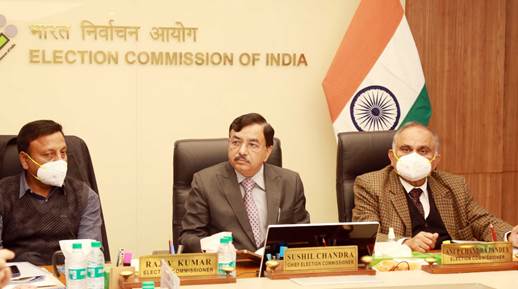
The Election Commission of India (ECI) held a meeting with representatives of various political parties at Nirvachan Sadan on Wednesday. Chief Election Commissioner Shri Gyanesh Kumar, along with Election Commissioners Dr. Sukhbir Singh Sandhu and Dr. Vivek Joshi, listened to the concerns and queries raised by the parties. They also explained the process of the ongoing Special Intensive Revision (SIR) of electoral rolls in Bihar, which is proceeding smoothly. Parties present included the Indian National Congress, Rashtriya Janata Dal, Samajwadi Party, DMK, NCP (Sharad Pawar faction), JMM, CPI(M), CPI(ML) Liberation, CPI, and Shiv Sena (Uddhav Balasaheb Thackeray faction).
The ECI informed them that the SIR is being conducted in a phased and structured way to ensure that all eligible citizens are included. A total of 1,54,977 Booth Level Agents (BLAs), appointed by recognised political parties across Bihar, are actively participating in the process to ensure transparency. CEC Gyanesh Kumar encouraged political parties to appoint more BLAs to support voter enrolment and enhance transparency.
In the first phase (25th June to 3rd July 2025), Enumeration Forms (EFs) are being printed and distributed to nearly 7.90 crore registered voters in Bihar. Electoral Registration Officers (EROs) are issuing partially pre-filled forms, based on the data available as of 23rd June, through 77,895 Booth Level Officers (BLOs). Another 20,603 BLOs are being added. These forms are delivered door-to-door to voters listed in the Electoral Roll as of 24th June 2025. The forms are also available for download on the ECI website, and BLAs can submit up to 50 certified forms daily.
In the second phase, voters are required to fill and submit the Enumeration Forms by 25th July 2025. Volunteers including government staff, NCC cadets, NSS members, etc., totaling around 4 lakh, are assisting BLOs in helping voters, especially those who are elderly, ill, disabled, poor, or otherwise vulnerable.
Voters whose names were on the electoral roll as of 1st January 2003 only need to submit the EF and the relevant roll extract—no further documents are needed. For others:
-
Those born before 1st July 1987 must submit proof of their own birth details.
-
Those born between 1st July 1987 and 2nd December 2004 must include their own and one parent’s document.
-
Those born after 2nd December 2004 need to submit documents for themselves and both parents.
If the elector’s parents were already listed in the 2003 electoral roll, no further parental documents are needed.
In the third phase (25th June to 26th July), BLOs will collect the completed forms along with self-attested documents. They will issue acknowledgment receipts and upload the data daily via the BLO App/ECINET. The physical forms will be submitted to EROs or AEROs. An online submission option for forms will also be launched.
In the fourth phase, the Draft Electoral Roll will be published on 1st August 2025. It will include only those names for which forms were submitted before 25th July. EROs and AEROs will verify each application according to eligibility norms under Article 326 of the Constitution. Copies of the Draft Roll will be provided to recognized political parties and uploaded online. Those who miss the deadline can still apply during the claims and objections window by filling Form 6. Post-publication, BLAs can submit 10 forms daily.
The fifth phase (1st August to 1st September) is the claims and objections period. During this, citizens can request corrections or object to entries in the Draft Roll. EROs/AEROs will examine these under Article 326 and Sections 16 and 19 of the Representation of the People Act, 1950. No entry will be removed without due process and a fair hearing. Daily lists of claims and objections will be available at ERO offices and on the Chief Electoral Officer’s website, with weekly updates shared with political parties.
The Final Electoral Roll will be published on 30th September 2025. Recognized political parties will receive both hard and soft copies free of charge, and it will also be uploaded online. Any voter dissatisfied with an ERO’s decision can appeal to the District Magistrate within 15 days under Section 24(a) of the RP Act, 1950. A second appeal to the Chief Electoral Officer can be made within 30 days if still unsatisfied.
The Election Commission has appealed to all eligible voters in Bihar to actively participate in this special revision exercise to ensure that every voter is included.