
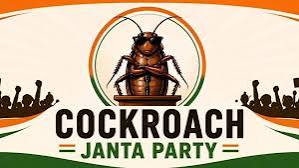
How the Cockroach Janta Party, a satirical social media page started by a graduate student, turned into a two-month protest movement that led to a Union minister’s resignation
NEW DELHI — Over roughly two months this summer, a protest movement called the Cockroach Janta Party grew from a social media page into large-scale demonstrations in Delhi and several other Indian cities. The Cockroach Janta Party’s protests included metro shutdowns, clashes with police involving tear gas and baton charges, and public statements from Bollywood actors and opposition politicians. The movement’s central demand, the resignation of Union Education Minister Dharmendra Pradhan, was met on July 25. The Cockroach Janta Party, widely known by its acronym CJP, has no political registration and no elected representatives; its founder, Abhijeet Dipke, is in his twenties.
The Spark: “Cockroaches” and “Parasites”
The chain of events began far from any protest site, inside a Supreme Court courtroom. On May 15, 2026, Chief Justice of India Surya Kant, hearing a case related to senior advocate designations and the use of fraudulent professional credentials, remarked: “There are youngsters like cockroaches, who don’t get any employment or have any place in the profession. Some of them become media, some of them become social media, RTI activists, and other activists, and they start attacking everyone.”
The comment landed in a country where youth unemployment had become a defining grievance. Kant later clarified that his remarks were aimed at people using fake or bogus degrees to enter the legal profession, and insisted he held “immense respect” for India’s youth. The clarification did little to contain the backlash.
Birth of the Cockroach Janta Party
The very next day, Abhijeet Dipke, a political communications strategist in his twenties who was studying at Boston University and had previously worked with the Aam Aadmi Party, posted a one-line provocation on social media: “What if all cockroaches came together?” The post went viral within hours.
By May 16, Dipke had launched a website under the tagline “Voice of the Lazy & Unemployed,” using AI tools including Claude and ChatGPT to design both the site and its mock manifesto, and AI-generated imagery to promote it. The name, Cockroach Janta Party, was a deliberate parody of the ruling Bharatiya Janata Party. Within days, the page had drawn more than 350,000 sign-ups and crossed 20 million Instagram followers, more than double the ruling party’s own following on the platform.
What began as pure satire (diaper-signing campaigns mailed to the education minister, plate-banging protests, cockroach costumes at clean-up drives) hardened over the following weeks into a movement with concrete, non-negotiable demands.
The Cockroach Janta Party’s Core Team
As the online phenomenon prepared to move offline, Cockroach Janta Party formalized its leadership in early June, naming three official spokespersons: investigative journalist and RTI activist Saurav Das as Chief Spokesperson, political researcher and filmmaker Vijeta Dahiya, and Ashutosh Ranka, an IIT Kanpur alumnus and former McKinsey consultant, as National Spokesperson. Dipke remained founder and public face of the movement throughout.
Their central demands crystallized around three points: the resignation of Union Education Minister Dharmendra Pradhan; blanket legal immunity for protesters, including withdrawal of FIRs; and roughly 1 crore in compensation for the families of NEET aspirants who died by suicide, alongside a package of institutional exam reforms.
The Exam Scandal Underneath
The movement’s demands were rooted in a separate, pre-existing crisis. The NEET-UG 2026 medical entrance exam, held on May 3, was cancelled by the National Testing Agency on May 12 after Rajasthan Police’s Special Operations Group uncovered a “guess paper” containing roughly 410 questions, around 120 of which reportedly matched the actual Biology and Chemistry sections, circulated beforehand via WhatsApp and Telegram groups. The government referred the matter to the CBI and ordered a re-examination for June 21, forcing roughly 2.2 million students to retake the test.
The fallout was measured in lives lost. As cited by the Cockroach Janta Party during the protests, a total of 21 students were stated to have died by suicide due to the stress and uncertainty caused by the exam cancellation and re-test. The Indian Express reported that some victims left notes saying they could not bear the prospect of sitting the exam again.
From Screens to the Streets
Cockroach Janta Party’s first physical demonstration was called for June 6 at Jantar Mantar, alongside established left-leaning student groups: the All India Students Federation, the All India Students Association, and the Students’ Federation of India. Turnout was initially modest; much of India’s mainstream television media largely ignored the demonstrations, pushing student organizers to document the protests themselves through Instagram reels and viral clips.
The demonstrations, held at Jantar Mantar (one of the few sites in Delhi where mass protest is permitted), were initially sanctioned by Delhi Police. Around the same time, Dipke and CJP organized similar sanctioned public gatherings in other states.
That changed after July 20, when the unauthorized march on Parliament and the resulting police crackdown pushed the movement into other cities. According to Wikipedia’s contemporaneous tracking of the protests and Al Jazeera’s coverage, solidarity protests and marches broke out in the days that followed in Mumbai, Chandigarh, Surat, Patna, Bengaluru, Hyderabad, Lucknow, Kolkata, and several Kerala cities including Thrissur, Kochi, Kozhikode and Thiruvananthapuram, several of them met with FIRs and baton charges of their own. Mumbai’s protests proved especially sustained, running continuously since at least July 18; Mumbai police registered FIRs against roughly 400 people for demonstrating without permission.
Wangchuk’s Fast
The movement’s turning point came on June 28, when Ladakhi engineer-turned-education-reformer Sonam Wangchuk joined the Jantar Mantar sit-in and began an indefinite hunger strike, demanding Pradhan’s resignation. According to a CJP press release, Wangchuk lost roughly 8 kg in his first 18 days of fasting. In mid-July, following a leadership change in Delhi Police, officers removed barricades at the site and transferred Wangchuk to a hospital, a move organizers called a forced, illegal detention. Wangchuk continued his fast even from his hospital bed.
July 20: The Reckoning
The confrontation peaked on July 20, the opening day of Parliament’s monsoon session, when more than 10,000 protesters attempted to march on Parliament. Authorities cut mobile internet around the protest site, erected barricades, and shut 16 metro stations, including Rajiv Chowk, Central Secretariat, Mandi House, ITO and Khan Market (repeated the next day as well). Delhi Police used tear gas, canes and batons to disperse the crowd, saying the march was unauthorized.
Delhi Police reported nearly 180 injuries (118 among security personnel, 60 among protesters) and 70 detentions. Dipke put the number of injured protesters far higher, at 150, and accused male officers of tearing the clothes of women demonstrators and beating them “black and blue,” calling Modi “a dictator.” The following day, citing safety concerns, Dipke announced CJP would not attempt another street march, though the Jantar Mantar sit-in would continue.
That same day, government outreach began: CJP spokespersons Saurav Das and Ashutosh Ranka met BJP president and Union minister J.P. Nadda, first delivering demands verbally around 11:50 a.m., then returning with a written memorandum by 4 p.m.
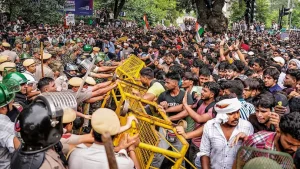
Cockroach Janta Party protest July 20 Parliament march Delhi”
Political and Cultural Reckoning
The political response split along familiar lines. The Aam Aadmi Party, Samajwadi Party, Shiv Sena (UBT), Trinamool Congress, CPI, CPI(ML)-Liberation and RJD backed the agitation, with DMK leaders also visiting the site. Congress initially held back (general secretary Jairam Ramesh noted “they are not a political party”), but party leader Rahul Gandhi later staged a sit-in outside Modi’s residence with dozens of Congress MPs, was briefly detained, and accused Modi and Home Minister Amit Shah of “destroying the future of India’s youth.” The next day, Congress MPs protested inside Parliament in solidarity.
Entertainment figures also weighed in publicly. Shabana Azmi and Prakash Raj joined demonstrators in person; Diljit Dosanjh, Sonakshi Sinha, Aditi Rao Hydari, Pooja Bhatt, Sonu Sood, Vir Das and Soha Ali Khan voiced support online; actress Ayesha Khan was detained by police at the protest site; rapper Hanumankind visited Jantar Mantar on July 21. On the other side, BJP MPs and actresses Kangana Ranaut and Hema Malini publicly criticized the protest tactics, with Ranaut arguing demonstrators should “stand for election” rather than pressure the government through street action.
Modi Breaks His Silence
Modi himself stayed publicly silent for weeks even as the crisis grew, prompting criticism that his government was out of touch with young voters. He finally addressed the nation directly on Thursday, July 23, posting a raw, self-recorded Instagram video, a break from his usual cinematic style, calling the scandal “extremely painful” and vowing accountability. A second reel followed, announcing fast-track courts for paper-leak cases and, later, a “high-powered task force” led by tech entrepreneur Nandan Nilekani to oversee exam reforms. Protesters said the response fell short, and hundreds returned to the streets on Friday even as authorities shut 18 metro stations across the city.
The Resolution
Talks accelerated through the week: a second round with Nadda and Minister of State Jitendra Singh took place July 24 at a neutral venue, the Constitution Club of India, where the government reportedly agreed to two conditional demands: no legal action against peaceful protesters, and compensation for affected families. Wangchuk broke his 26-day fast that Thursday night, citing “a long negotiation on various conditions” and concern over “possible violence in the country.”
On Saturday, July 25, Dharmendra Pradhan resigned as education minister, writing in a formal, two-page Hindi-language letter that he was “deeply pained” by recent events while blaming “anti-national forces” for exploiting the protests. Cockroach Janta Party declared victory, posting: “Remember, do not mess with cockroaches.” Union minister Pralhad Joshi, who already held the consumer affairs and renewable energy portfolios, was given additional charge of the education ministry the same day.
Aftermath
Cockroach Janta Party called off its nationwide protests but said its fight was not over, pressing for compensation for suicide victims’ families and accountability for the officers involved in the July 20 crackdown. A fourth round of government talks was scheduled for four weeks later. On July 26, in a show of international solidarity, the Students Federation of India (UK) held a demonstration at London’s Trafalgar Square, attended by climate activist Greta Thunberg, to mark Pradhan’s resignation.
What started as a joke about insects had, in ten weeks, rewritten the terms of engagement between India’s Gen Z and its government, a reminder, as analysts noted, that the shrinking space for dissent under Modi’s decade-plus in power had not extinguished the appetite for it.