
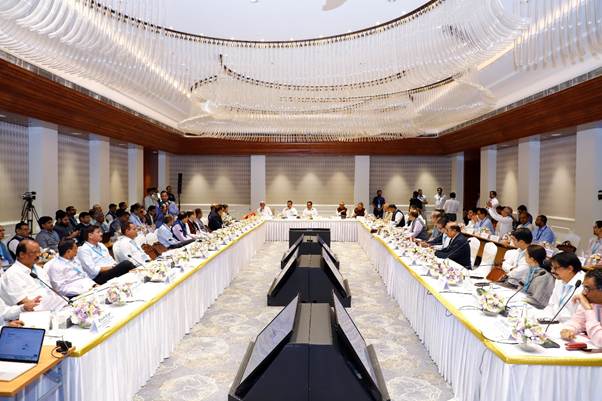
C R Patil chairs the 19th Ganga Flood Control Board meeting in New Delhi, reviewing flood management plans, groundwater recharge technology and Centre-State coordination.
Ganga Flood Control Board Meeting: Union Jal Shakti Minister C R Patil chaired the 19th meeting of the Ganga Flood Control Board (GFCB) at Bharat Mandapam in New Delhi on Thursday. The meeting focused on improving flood preparedness, strengthening coordination between states and the Centre, and adopting modern technology for flood management across the Ganga Basin. West Bengal Chief Minister Suvendu Adhikari also attended the meeting.
According to the Union Ministry of Jal Shakti, discussions covered ongoing flood management initiatives, institutional reforms and measures to improve the planning and execution of projects. The Ganga Flood Control Board meeting also reviewed strategies for addressing river-related challenges, including erosion, sedimentation, drainage congestion and infrastructure-related risks.
C R Patil Launches Punah Bharan Mobile App for Groundwater Recharge
During the Ganga Flood Control Board Meeting, C R Patil launched the Punah Bharan Mobile App, developed by the Bhaskaracharya National Institute for Space Applications and Geo-informatics in collaboration with the National Water Mission.
The application is designed to support the scientific identification of suitable locations for artificial groundwater recharge. By helping identify potential recharge sites, the app aims to support more informed planning of groundwater replenishment interventions.
The launch marked one of the key technology-focused developments discussed at the Ganga Flood Control Board meeting, where officials emphasised the role of modern tools and scientific assessments in improving water resource management.
Ganga Flood Control Commission to Undergo Structural Reforms
The Board deliberated on the revised mandate and restructuring of the Ganga Flood Control Commission (GFCC). The proposed changes focus on strengthening basin-level flood management planning and improving the technical assessment of flood control schemes.
Key areas under discussion included river morphology studies, sedimentation analysis and the development of a Flood Management Information System (FMIS). These measures are intended to improve the availability of technical information, support better coordination and facilitate timely decisions on flood management projects.
The revised institutional framework is also expected to strengthen the appraisal process for schemes and encourage a more coordinated approach to managing flood risks across the Ganga Basin.
also read”:- PM Modi Inaugurates ESTIC 2026, Calls For Faster Science…
Focus on Basin Master Plans and Timely Project Execution
The meeting highlighted the need to prepare risk-based master plans for river basins. Such plans can help identify vulnerable areas, assess flood risks and guide the prioritisation of mitigation measures.
Participants also discussed the adequacy of waterways and ventways beneath bridges, which are important for ensuring the smooth passage of floodwater. Improving the quality of Detailed Project Reports (DPRs) and ensuring timely implementation of flood management projects were other major priorities.
The Ministry further highlighted the importance of modern survey methods, detailed technical investigations and the use of advanced technologies to improve the planning and delivery of flood protection measures.
The Ganga Flood Control Board meeting also stressed the need to address implementation delays and resolve bottlenecks that can affect the progress of flood management projects.
Centre-State Coordination to Strengthen Flood Resilience
The discussions underlined the importance of cooperation among Central Ministries, State Governments and other stakeholders. Coordinated action is particularly important for addressing challenges related to changing river patterns, sediment accumulation, drainage congestion and infrastructure development.
Officials also emphasised the need for appropriate statutory clearances and timely resolution of issues that delay project implementation. Better technical standards and effective coordination are expected to support more reliable and sustainable flood management interventions.
The Board reaffirmed the importance of an integrated, risk-based and technology-enabled strategy for flood management. The approach aims to combine scientific planning, improved project assessment and coordinated implementation across the Ganga Basin.
What Is the Ganga Flood Control Board?
The Ganga Flood Control Board was established by the Government of India on April 18, 1972. Its primary objective is to facilitate coordinated planning and implementation of measures to address flooding, river erosion and drainage problems in the Ganga Basin.
The Board is chaired by the Union Minister of Jal Shakti and includes representatives from relevant Central Ministries and the Chief Ministers of Ganga Basin states, or their representatives. The Chairman of the Ganga Flood Control Commission serves as the Board’s Member Secretary.
Through this institutional platform, the Ganga Flood Control Board seeks to improve cooperation between the Centre and states and promote coordinated action on flood-related challenges.
The latest Ganga Flood Control Board Meeting reiterated the need for stronger institutional coordination, better technical planning and wider use of modern technology to improve flood preparedness and resilience throughout the Ganga Basin.
For More Hindi news: http://newz24india.com