
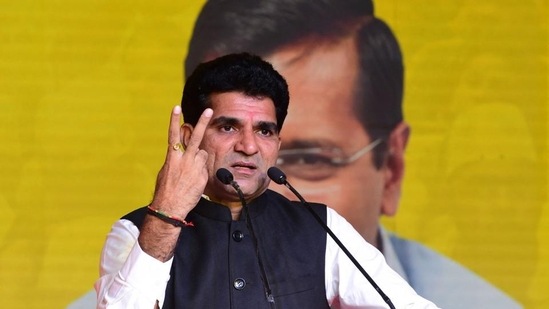
Isudan Gadhvi questions Gujarat’s new school access notification, alleging it could restrict scrutiny of government school conditions and teacher shortages.
A new notification concerning access to government schools in Gujarat has triggered a political controversy, with Aam Aadmi Party (AAP) state president Isudan Gadhvi accusing the BJP-led government of restricting scrutiny of public education institutions. Gadhvi alleged that the move could prevent the public from learning about problems in government schools, including damaged buildings and a shortage of teachers.
Reacting to the notification, Gadhvi said the decision was unfair to students studying in government schools and their parents. He questioned why journalists, opposition representatives, members of civil society groups and young people should face restrictions when seeking to visit schools. The Gujarat government school notification has become a point of political contention, with AAP demanding greater transparency and accountability from the state government.
Isudan Gadhvi Questions BJP Government’s Education Policy
Gadhvi criticised the BJP’s long tenure in Gujarat, alleging that government schools and their infrastructure had deteriorated over the years. He claimed that concerns about schools operating with a single teacher and buildings in poor condition had previously been raised in the state Legislative Assembly.
According to the AAP leader, the government should focus on improving school infrastructure, addressing teacher shortages and ensuring quality education instead of limiting access to educational institutions.
He further alleged that the latest Gujarat government school notification could make it harder for people to identify schools facing serious challenges. Gadhvi claimed that the timing of the order raised questions about whether the government wanted to prevent the issue from becoming a major public debate ahead of the 2027 elections.
These statements represent the AAP leader’s allegations. The notification’s precise scope and the government’s stated reasons would need to be assessed from the official order.
Restrictions on School Visits Become a Political Flashpoint
Gadhvi said the notification requires prior permission from a school principal for certain visits, citing concerns about students’ privacy and possible disruption. He argued that the rules could affect journalists, opposition leaders, civil society representatives and young people who want to understand the conditions inside government schools.
also read:- Manoj Sorathiya Leads AAP Organizational Meeting In…
The AAP leader questioned whether child safety and privacy concerns were being used to justify restrictions on public scrutiny. He maintained that safeguarding students and allowing legitimate oversight should go hand in hand.
The Gujarat government school notification has therefore raised questions about how the state balances student protection, school administration and transparency. The exact implications will depend on the wording of the order and how authorities implement it.
Gadhvi Cites Delhi Government Schools as an Example
Drawing a comparison with Delhi, Gadhvi referred to the former AAP government’s approach to public education under Arvind Kejriwal. He said that people had been encouraged to visit Delhi government schools and learn from their education model.
Gadhvi contrasted that approach with what he described as restrictions on school visits in Gujarat. He argued that governments should welcome scrutiny of public institutions and use feedback to improve facilities and learning outcomes.
He also alleged that references to laws such as the Protection of Children from Sexual Offences (POCSO) Act could discourage people from raising concerns about government schools. However, his comments do not independently establish that the law has been invoked in connection with the notification.
AAP Calls for Public Support and Legal Review
Gadhvi appealed to parents, students, young people and members of Gen-Z across Gujarat to speak out about the issue. He encouraged citizens to share their concerns on social media and participate in the public discussion surrounding government school conditions.
The AAP leader also said he would explore the legal options available in response to the notification. He challenged the state government to explain the rationale behind the order and clarify the rules governing access to government schools.
Gadhvi maintained that the Gujarat government school notification should not become an obstacle to raising legitimate concerns about educational infrastructure, teacher availability and students’ learning environments.
Transparency and Student Safety at the Centre of Debate
The controversy highlights a broader question about accountability in public education. Schools must protect children’s privacy, safety and uninterrupted learning, while also ensuring that concerns about infrastructure and educational quality can be examined through appropriate and lawful channels.
The debate over the Gujarat government school notification is likely to depend on the official text of the order, the reasons provided by the government and how the rules are applied in practice. A clear explanation from the authorities could help establish whether the notification is intended to protect students and maintain school functioning or whether it places broader limits on legitimate scrutiny.
For now, AAP has demanded transparency and accused the BJP-led government of avoiding questions about the condition of government schools. The allegations and the notification’s actual provisions remain central to the unfolding political debate.
For More Hindi News: http://newz24india.com