
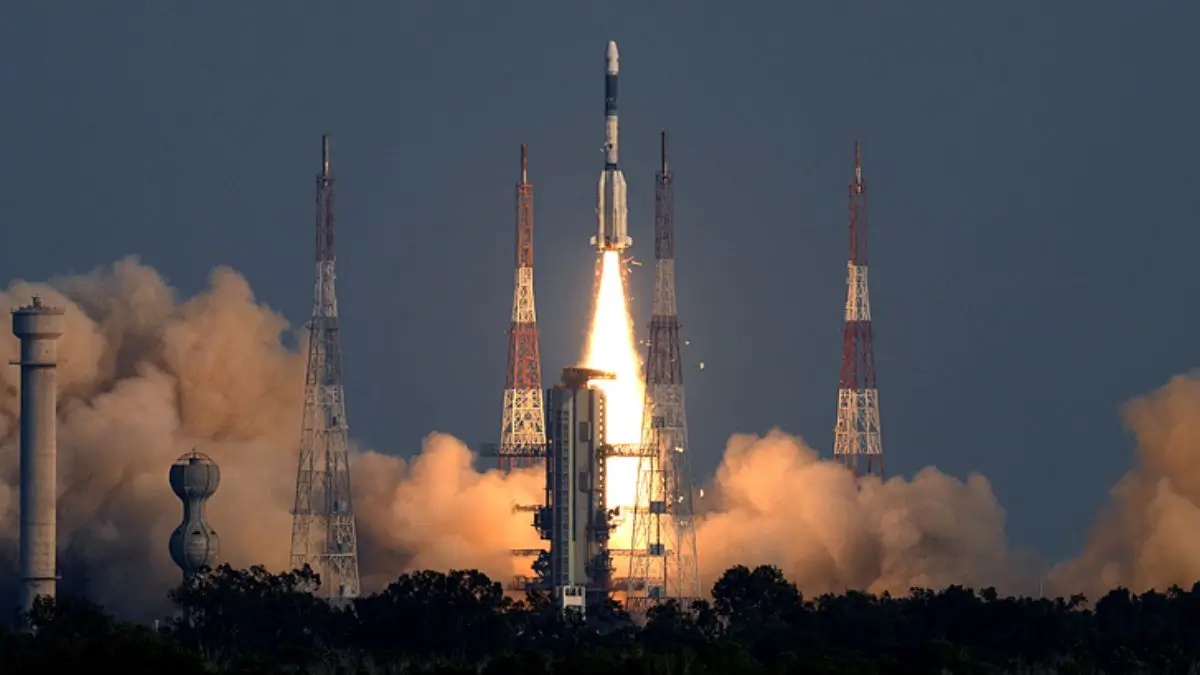
ISRO Chairman V Narayanan says India plans four functional launch pads by 2029, alongside Gaganyaan tests and the Chandrayaan-5 lunar mission.
ISRO space expansion: India is preparing to significantly increase its space launch capabilities, with four functional launch pads planned by 2029, according to ISRO Chairman V Narayanan. The expansion includes a dedicated small satellite launch complex at Kulasekarapattinam in Tamil Nadu and a third launch pad at Sriharikota, aimed at meeting the growing demand for satellite launches in India and across the world.
Narayanan shared these plans while addressing a convocation ceremony at a private university in Porur, near Chennai. The proposed infrastructure is expected to strengthen India’s launch capacity and support the country’s expanding space programme.
Kulasekarapattinam Spaceport to Strengthen Small Satellite Launches
A key part of the ISRO space expansion plan is the development of a dedicated 2,000-acre facility for Small Satellite Launch Vehicles (SSLVs) at Kulasekarapattinam in Tamil Nadu’s Thoothukudi district.
According to the ISRO Chairman, the upcoming spaceport will include several essential facilities to support satellite launch operations. These will include integration buildings, launch pads, rail-track systems, and telemetry, tracking and command infrastructure.
The dedicated complex is intended to support small satellite launches and help India respond to increasing demand for affordable and timely access to space. The proposed third launch pad at Sriharikota will further add to the country’s launch infrastructure.
Gaganyaan Mission: First Uncrewed Test Expected Soon
Narayanan also provided an update on India’s human spaceflight programme, Gaganyaan. He said ISRO planned to conduct the first uncrewed test within the following two months, followed by two additional uncrewed missions before attempting a crewed flight.
These test missions are designed to assess critical systems required to ensure astronaut safety. The evaluations will cover environmental control systems, crew escape mechanisms, safety features and the spacecraft’s internal conditions under different pressure, temperature and humidity levels.
The ISRO Chairman also stated that approximately 8,000 ground-based experiments had been conducted for the mission. Meanwhile, the four astronaut-designates selected for the programme are undergoing specialised training.
The uncrewed missions will help engineers evaluate the spacecraft’s performance and address potential technical challenges before astronauts travel to space.
Chandrayaan-5 to Feature a 350-Kg Rover
India is also preparing for another major lunar exploration effort through Chandrayaan-5, a collaborative mission involving Japan’s space agency.
Narayanan said the mission would feature a rover weighing approximately 350 kilograms, designed to conduct experiments on the lunar surface over a period of 100 days.
also read:- Rajnath Singh Calls Mallikarjun Kharge’s Remarks On PM…
The planned mission highlights India’s continuing interest in lunar exploration and international cooperation in space science. The rover’s surface operations are expected to contribute to scientific investigations, although further mission details and timelines will depend on subsequent programme developments.
ISRO Will Not Be Privatised, Says Chairman
Addressing concerns about the future of India’s space programme, Narayanan clarified that ISRO would not be privatised. He emphasised that collaboration with private companies is necessary to meet the rapidly increasing demand for satellite launches and space-related services.
Private-sector participation has become an important part of India’s space ecosystem, with companies contributing to satellite manufacturing, launch technologies and other space activities.
The growing number of satellites required for communication, Earth observation and other applications has increased the need for launch capacity. Partnerships between ISRO and private enterprises can help address these requirements while allowing the national space agency to continue its scientific and strategic missions.
India’s Space Programme Set for a Major Expansion
The proposed launch infrastructure, Gaganyaan test programme and Chandrayaan-5 mission represent several important areas of India’s developing space ambitions.
The ISRO space expansion plan aims to increase launch capacity by 2029 through additional facilities at Kulasekarapattinam and Sriharikota. Alongside these infrastructure projects, human spaceflight preparations and lunar exploration remain important priorities.
As demand for satellite launches continues to grow, the combination of new launch facilities, advanced missions and private-sector partnerships could help India strengthen its position in the global space industry. The planned milestones will depend on the progress of infrastructure development, technical testing and official mission schedules.
For More Hindi News: http://newz24india.com