
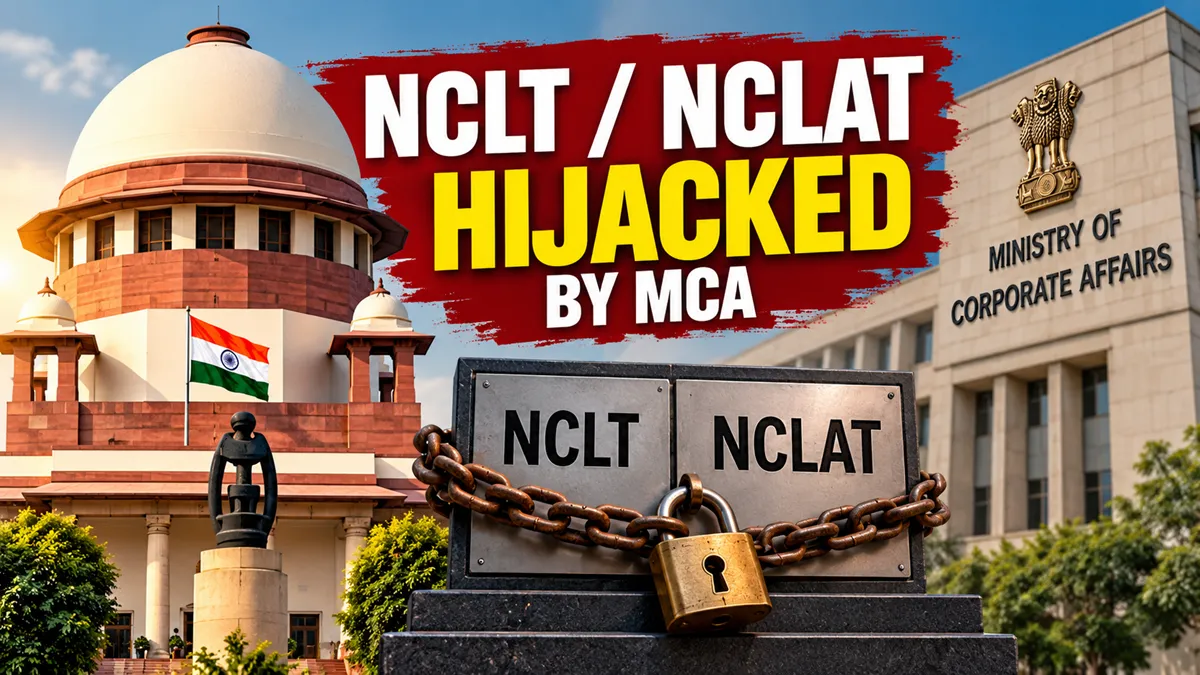
Supreme Court criticises the Ministry of Corporate Affairs over NCLT control and calls for greater tribunal autonomy, regular recruitment and staff reforms.
The Supreme Court has raised serious concerns over the functioning and administrative independence of the National Company Law Tribunal (NCLT) and its appellate body, the National Company Law Appellate Tribunal (NCLAT). During a hearing on Thursday, the court orally observed that the Ministry of Corporate Affairs (MCA) had gained excessive control over the tribunals, affecting their institutional autonomy.
A bench comprising Chief Justice of India Surya Kant and Justices Joymalya Bagchi and V. Mohana made the observations while hearing a petition filed by contractual employees working in the NCLT and NCLAT. The Supreme Court on NCLT autonomy issue came into focus as the bench discussed the need to give tribunal presidents greater authority over appointments and administrative decisions.
Supreme Court Questions MCA’s Control Over NCLT
Chief Justice Surya Kant remarked that the tribunals should have complete autonomy, particularly in matters concerning staff appointments. He suggested that the presidents of the NCLT and NCLAT should be allowed to recruit personnel with assistance from agencies such as the Union Public Service Commission (UPSC) or the Staff Selection Commission (SSC).
The CJI expressed concern that excessive dependence on private contractors could affect the functioning of judicial and technical members. He said the Ministry of Corporate Affairs appeared to be exercising significant control over the institutions, which was not in the interest of their independence.
The Supreme Court on NCLT autonomy discussion also included suggestions for bringing experienced government employees into the tribunals through deputation as an immediate arrangement.
also read:- C R Patil Chairs 19th Ganga Flood Control Board Meeting…
Contractual Employees Raise Concerns Over Termination
Senior advocate Meenakshi Arora, representing the contractual employees, argued that workers who had served the tribunals for several years should not be removed without proper consideration. She told the court that the existing contract had reportedly been awarded to an independent private company and that the current staff could be asked to leave around November 1 or 2.
Arora pointed out that several employees had worked for nearly six years. She argued that their long service and the applicable recruitment rules deserved consideration before any decision was taken to replace them.
She also referred to provisions in the NCLT recruitment rules and the relevant advertisement, arguing that they provided for regularisation. According to her, removing the employees collectively without approval from the tribunal president could raise concerns under Articles 14 and 16 of the Constitution.
CJI Suggests Deputation and Regular Recruitment
The Chief Justice expressed reservations about relying on contractual appointments for tribunal staff. Referring to an earlier incident in Bombay, he said contractual employees had allegedly taken away original reports, following which FIRs had to be registered.
The CJI also raised concerns about the treatment of judicial and technical members by contractual staff. He indicated that the existing arrangement needed to be reconsidered and that the tribunals should have greater control over their administrative workforce.
As an interim measure, the bench suggested appointing experienced personnel from government departments on deputation. For the long term, it recommended that the NCLT and NCLAT conduct recruitment in phases with assistance from the UPSC or SSC.
The Supreme Court on NCLT autonomy matter therefore involves both the future of contractual employees and the broader question of how tribunal administration should be managed.
Supreme Court Issues Notice on the Petition
The bench emphasised the need for both short-term and long-term solutions to address the administrative issues. It suggested that the tribunals should gradually develop their own recruitment systems rather than remain dependent on contractual arrangements.
The Supreme Court issued notice on the petition, observing that the matter involved broader institutional interests. The court’s remarks were made orally during the hearing, and the final outcome will depend on further proceedings.
The Supreme Court on NCLT autonomy debate has brought attention to the balance between government oversight and the independent functioning of judicial institutions, along with the rights of employees who have served the tribunals for extended periods.
For More Hindi news: http://newz24india.com