
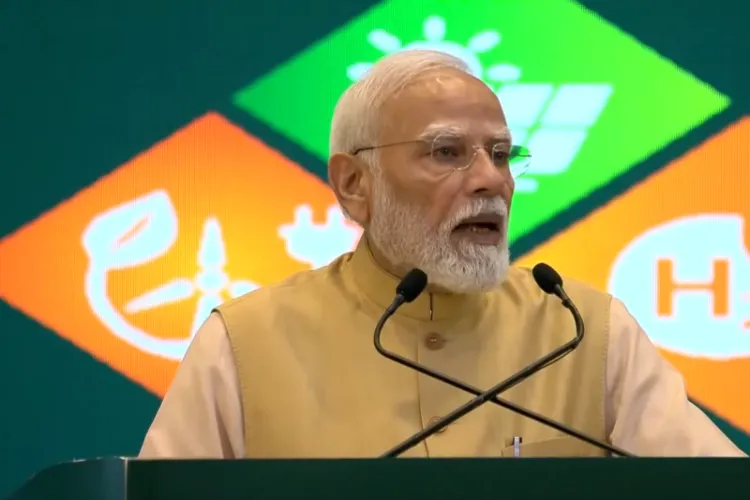
PM Modi highlights clean energy as the future of energy security at BRESE 2026, showcasing India’s renewable energy achievements, green hydrogen mission and investment opportunities.
Prime Minister Narendra Modi has emphasised that clean energy will play a crucial role in ensuring future energy security and strengthening economic stability. Addressing the Bharat Renewable Energy Summit & Expo (BRESE) 2026 at Bharat Mandapam, New Delhi, he said that excessive dependence on fossil fuels continues to expose the global economy to disruptions. He highlighted India’s growing renewable energy capacity and investments, stating that the country is moving steadily towards a sustainable energy future.
Clean Energy Is Essential for Global Energy Security
Speaking at BRESE 2026, PM Modi said recent global challenges, including the COVID-19 pandemic and the ongoing crisis in West Asia, have demonstrated how closely energy security is linked to economic security.
According to the Prime Minister, countries must reduce their dependence on conventional fossil fuels and explore renewable alternatives to protect their economies from international disruptions.
He stated that fossil fuel reserves are limited and concentrated in certain regions, whereas renewable energy resources offer opportunities to every country.
PM Modi said, “The future of energy security lies in clean energy.” He added that continued dependence on fossil fuels could create further uncertainty for the global economy.
India Achieves Paris Climate Commitment Five Years Early
Highlighting India’s progress in renewable energy, the Prime Minister said the country achieved its Paris Agreement commitment in 2025, five years ahead of the original 2030 deadline.
India has crossed the milestone of generating more than 50 per cent of its total installed electricity capacity from non-fossil fuel sources. The country’s non-fossil energy capacity has reached nearly 300 gigawatts.
PM Modi also reiterated India’s ambitious target of achieving 500 GW of non-fossil fuel-based energy capacity by 2030. Over the next 10 to 11 years, the country plans to add another 500 GW of non-fossil energy capacity.
These developments highlight India’s growing commitment to clean energy and its efforts to establish a sustainable power infrastructure.
PM Surya Ghar Scheme Connects More Than 65 Lakh Homes
The Prime Minister also discussed the achievements of the PM Surya Ghar Muft Bijli Yojana, which was launched in February 2024 with the objective of providing rooftop solar facilities to one crore households.
According to PM Modi, more than 65 lakh households have been connected under the scheme over the last two years. The initiative has helped beneficiaries reduce their electricity expenses by approximately 76 per cent.
He also highlighted the contribution of the PM-KUSUM scheme, which is supporting farmers through solar energy installations.
More than 30 lakh farmers are benefiting from solar installations under the initiative, with estimated annual savings of around Rs 1 lakh per farmer.
Additionally, solar energy systems have been installed across more than 44,000 government buildings. These installations are generating annual savings of approximately Rs 700 crore.
India Moving Ahead with Green Hydrogen Mission
PM Modi said India’s clean energy strategy is not limited to solar, wind, hydropower and nuclear energy. The country is also working towards becoming a major player in green hydrogen production.
Under the National Green Hydrogen Mission, India has set a target of producing 5 million tonnes, or 50 lakh tonnes, of green hydrogen annually by the end of this decade.
The initiative is expected to support cleaner industrial production, reduce dependence on conventional fuels and create new opportunities in the emerging green energy sector.
The Prime Minister said India is taking significant steps to develop the infrastructure and technology required to strengthen its position in the global green hydrogen industry.
also read:- SSC Exam Calendar 2026 OUT: Check Complete November Exam…
Rs 2 Lakh Crore Investment to Strengthen Green Energy Infrastructure
Discussing the expansion of renewable energy infrastructure, PM Modi highlighted India’s unified national electricity grid and dedicated green energy corridors.
He said the government has taken an investment decision involving approximately Rs 2 lakh crore to strengthen the country’s green energy transmission infrastructure.
The objective is to improve the distribution of renewable electricity and ensure that power generated from solar and wind projects can reach different parts of the country efficiently.
India has also made significant progress in domestic solar manufacturing. A decade ago, the country’s solar module manufacturing capacity stood at around 2 GW. It has now increased to more than 200 GW.
Meanwhile, domestic solar cell manufacturing capacity has reached approximately 40 GW, strengthening India’s position in the global solar supply chain.
Renewable Energy Sector Attracts Over Rs 15 Lakh Crore Investment
The Prime Minister also highlighted the growing investment opportunities in India’s renewable energy industry.
He said the sector has attracted investments exceeding Rs 15 lakh crore, equivalent to approximately USD 164 billion, over the past decade.
Since the RE-Invest Summit in 2024, India has received investments of around Rs 6 lakh crore, or more than USD 63 billion, within two years.
PM Modi further stated that the renewable energy sector could offer investment opportunities worth over Rs 20 lakh crore, approximately USD 220 billion, by the end of this decade.
These investments are expected to support infrastructure development, manufacturing, technological innovation and employment generation.
India Proposes $200 Million Africa Solar Facility
The Bharat Renewable Energy Summit & Expo 2026 was organised alongside the 9th Assembly of the International Solar Alliance and the 4th International Green Hydrogen Conference.
During the event, PM Modi reiterated India’s proposal for a $200 million Africa Solar Facility.
The proposed initiative aims to support developing economies by improving access to solar technology, financial resources and renewable energy solutions.
India’s initiative reflects its broader vision of promoting international cooperation in clean energy and making sustainable power accessible to more countries.
With expanding renewable energy capacity, growing domestic manufacturing and increasing investments, India is strengthening its position in the global clean energy landscape. PM Modi’s message at BRESE 2026 made it clear that clean energy will remain central to the country’s long-term energy security and economic development.
For More Hindi News: http://newz24india.com