
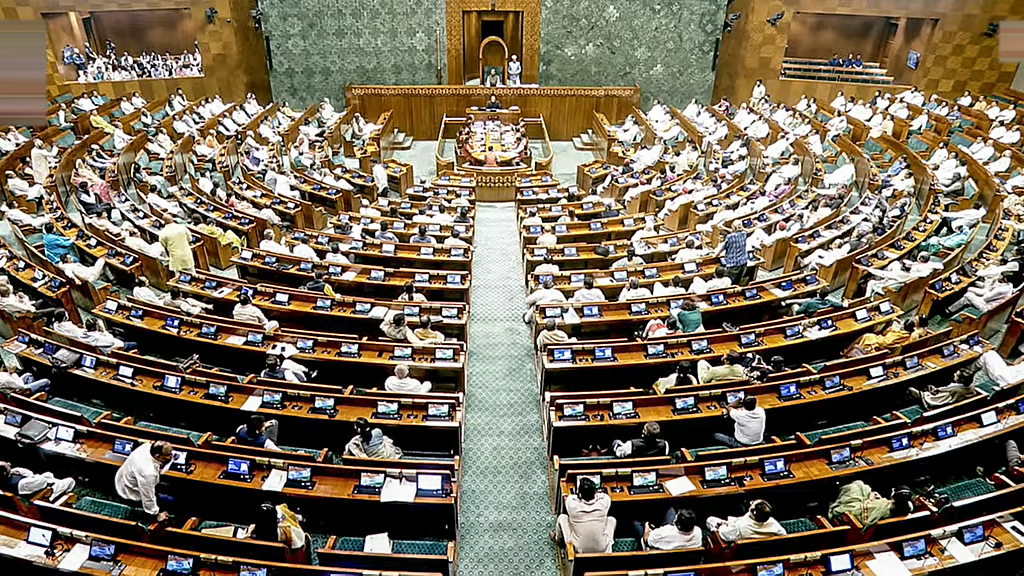
Anti-Paper Leak Bill Passed Through Voice Vote as Opposition Walks Out of Lok Sabha
The Anti-Paper Leak Bill was passed by the Lok Sabha on Tuesday amid an Opposition walkout following a heated exchange over Leader of Opposition Rahul Gandhi’s remarks against Union Home Minister Amit Shah. The legislation, officially titled the Public Examinations (Prevention of Unfair Means) Amendment Bill, 2026, was approved through a voice vote despite repeated sloganeering and disruptions from Opposition benches.
The Anti-Paper Leak Bill was introduced after the nationwide controversy surrounding the alleged NEET-UG paper leak and seeks to amend the existing law governing unfair means in public examinations. According to the government, the amendments are intended to strengthen the legal framework against examination fraud through stricter penalties, faster investigations and time-bound judicial proceedings.
The passage of the Anti-Paper Leak Bill comes amid continuing public debate over the security and credibility of competitive examinations, with repeated instances of alleged paper leaks prompting demands for stronger legal safeguards and quicker prosecution of offenders.
Anti-Paper Leak Bill Proposes Stricter Punishment, Fast-Track Courts and Time-Bound Investigations
The Anti-Paper Leak Bill proposes several changes to the Public Examinations (Prevention of Unfair Means) Act, 2024.
Among its key provisions, the Bill mandates that investigations into paper leak cases be completed within two months. It also proposes increasing the maximum punishment for individuals found guilty of using or facilitating unfair means in public examinations from five years’ imprisonment under the existing law to ten years, along with a fine of ₹50 lakh.
The Anti-Paper Leak Bill further proposes the establishment of fast-track courts to dispose of paper leak cases within three months. For organised offenders, the proposed legislation raises the maximum financial penalty to ₹10 crore, replacing the lower ceiling provided under the existing Act.
According to the government, these amendments are intended to ensure quicker investigation, prosecution and adjudication of cases related to examination fraud. The proposed changes also seek to strengthen legal action against organised networks allegedly involved in paper leak rackets.
The amendments come days after Prime Minister Narendra Modi announced that the Centre would introduce stronger legal measures to tackle examination fraud following protests over the alleged NEET-UG paper leak. In a statement posted on X, the Prime Minister said the government was committed to ensuring that those responsible for paper leaks face strict legal action.
Anti-Paper Leak Bill Debate Overshadowed by Rahul Gandhi-Amit Shah Confrontation
Discussion on the Anti-Paper Leak Bill was accompanied by sharp political exchanges inside the Lok Sabha.
During the debate, Rahul Gandhi defended the recent student protests over alleged examination irregularities, describing them as an expression of the aspirations and concerns of the country’s youth. His speech, however, triggered protests from treasury bench members after he used the words “idiot” and “andhbhakt” while recounting a conversation with a student.
The confrontation escalated further after Gandhi alleged that Union Home Minister Amit Shah had authorised police action during the Cockroach Janata Party (CJP)-led Parliament march and claimed that the Home Minister had “ordered the shooting” of students. BJP members objected to the allegations, demanded supporting evidence and called on the Congress leader to apologise.
Amid the uproar, Lok Sabha Speaker Om Birla ordered portions of Gandhi’s speech containing what he described as unparliamentary expressions to be expunged from the official record. Opposition members later staged a walkout while proceedings continued in the House, after which the Anti-Paper Leak Bill was passed through a voice vote.
Anti-Paper Leak Bill Introduced After NEET-UG Paper Leak Controversy
The Anti-Paper Leak Bill follows widespread protests over alleged examination irregularities, particularly the NEET-UG paper leak, which prompted demands for stronger legal safeguards against organised examination fraud.
Student groups and several opposition parties had called for greater accountability after the controversy, while the Centre maintained that stricter legal provisions were necessary to protect the integrity of public examinations.
With the Lok Sabha approving the Anti-Paper Leak Bill, the proposed amendments represent the Centre’s latest legislative response to examination-related malpractice. The Bill will now undergo the remaining stages of the legislative process before the amended provisions can come into effect.