
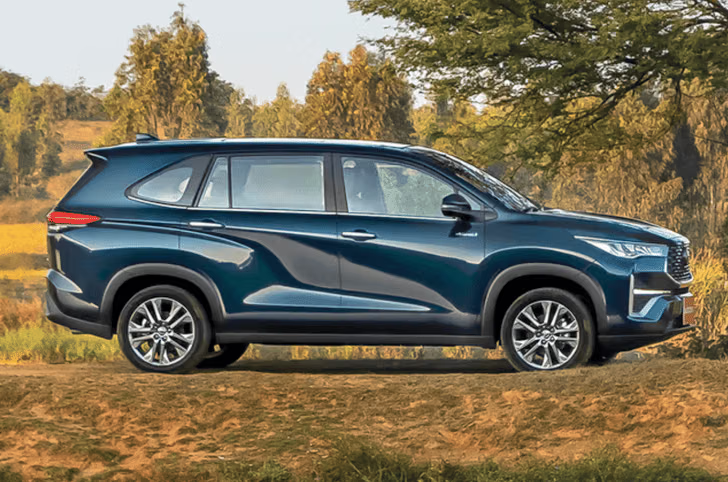
Toyota is implementing a massive “Beyond Zero” transformation, shifting from a traditional car manufacturer to a total mobility provider. This new model wave is defined by a multi-pathway strategy that balances electrification with traditional reliability.
Multi-Pathway Electrification Strategy
Toyota is not betting on a single technology. Instead, it is pushing a Multi-Pathway Electrification Strategy that includes Battery EVs (BEVs), Hybrids (HEVs), and Plug-in Hybrids (PHEVs) to suit different global markets and infrastructure levels.
also read : Forza Horizon 6: Why It’s The Best Controller Racing Game Without A Sim Rig
Next-Gen BEV Factory & Giga Casting
To streamline production for 2026, Toyota has launched a dedicated Next-Gen BEV Factory. This involves revolutionary manufacturing techniques like Giga Casting, which reduces vehicle complexity by modularizing the chassis into three main parts, cutting both weight and costs.
Advanced Battery Technology Roadmap
A central focus of the 2026 wave is the Advanced Battery Technology Roadmap. Toyota is working toward performance batteries offering up to 1,000 km of range and is heavily investing in the commercialization of all-solid-state batteries to offer ultra-fast charging.
Software-Defined Vehicles (Arene OS)
Future Toyota models are being developed as Software-Defined Vehicles. By utilizing the proprietary Arene OS, Toyota can provide over-the-air (OTA) updates, allowing a car’s safety features, infotainment, and driving dynamics to improve long after it leaves the showroom.
Hydrogen Fuel Cell Expansion
The “Beyond Zero” vision includes a major Hydrogen Fuel Cell Expansion. Toyota is refining its third-generation fuel cell systems for heavy-duty trucks and commercial transport, aiming for a 20% increase in efficiency and significantly lower production costs by 2026
Carbon Neutral Mobility Solutions
Toyota is looking beyond the tailpipe to achieve Carbon Neutral Mobility Solutions. This involves a holistic approach to the vehicle lifecycle, focusing on sustainable manufacturing plants, recyclable battery materials, and the use of carbon-neutral fuels for existing internal combustion engines.
For More Hindi News: http://newz24india.com