
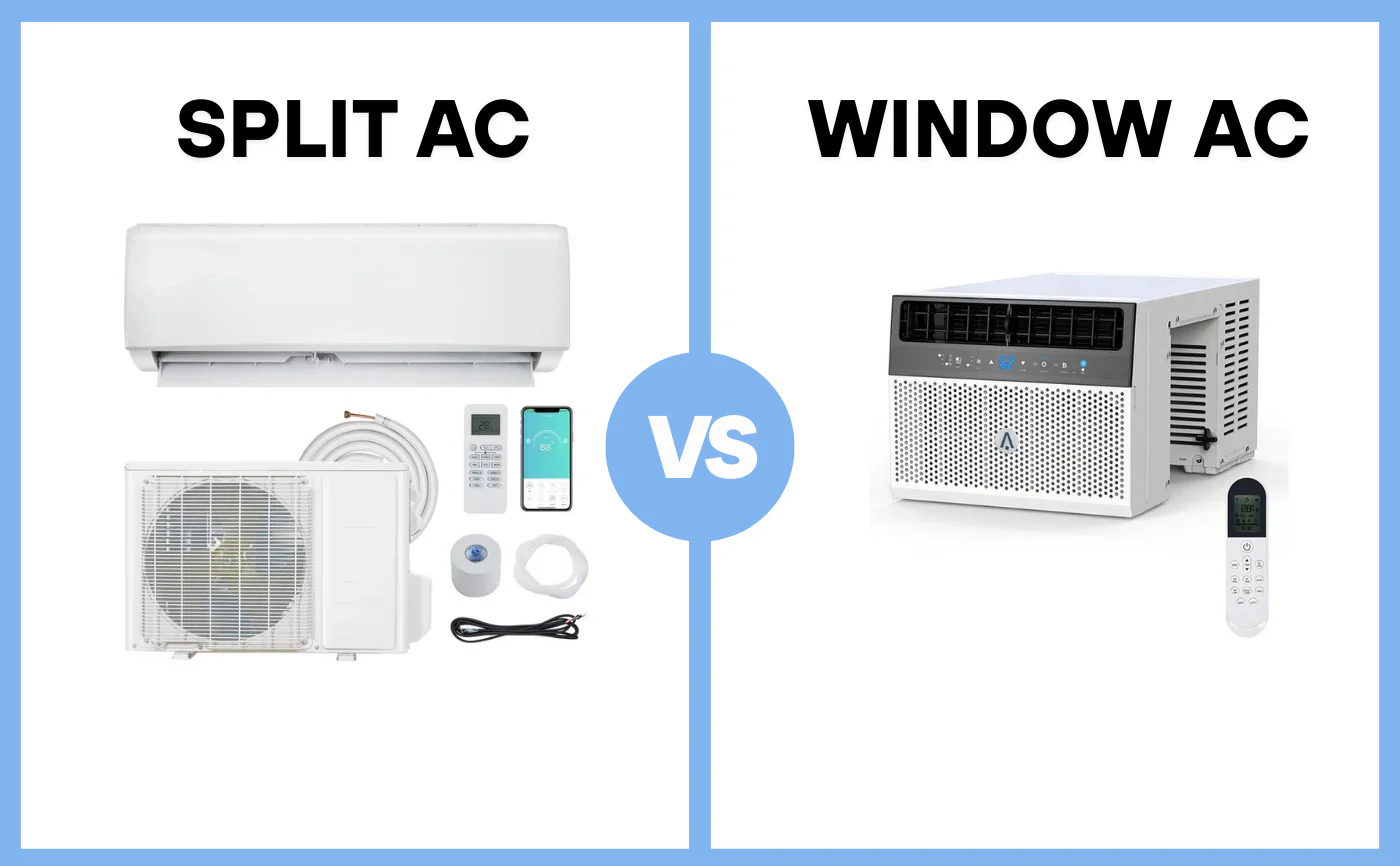
Choosing between a window AC vs split AC is more than just a matter of price; it’s about balancing your room’s layout with long-term energy savings. With new BEE (Bureau of Energy Efficiency) standards taking effect in 2026, the technology behind both types has evolved to be smarter and more efficient than ever.
Here is the essential breakdown of the window AC vs split AC debate to help you decide which cooling system fits your lifestyle.
Window AC vs Split AC: Pros, Cons, and Key Specsification
Installation and Space Economy: A window AC vs split AC comparison starts with setup; window units are “plug-and-play” but require a specific window or wall cutout, whereas split units need professional piping but offer more placement flexibility.
Noise Levels and Sleep Comfort: When comparing window AC vs split AC for bedrooms, split models are significantly quieter (30-40 dB) because the noisy compressor sits outside, while window units (45-55 dB) house all components in one box.
Also read:
Energy Efficiency and Inverter Tech: In the battle of window AC vs split AC efficiency, split inverter models generally win with higher ISEER ratings, though 2026’s new 5-star inverter window ACs are closing the gap for smaller rooms.
Cooling Coverage and Airflow: A window AC vs split AC choice often depends on room size; window units are ideal for spaces up to 150 sq. ft., while split systems use wider blowers to cool large halls up to 450 sq. ft. more evenly.
Upfront Cost vs Long-Term Value: The initial price of a window AC vs split AC favors the window unit for budget buyers, but the lower monthly electricity bills of a high-star split unit often make it the cheaper option over five years.
Maintenance and Air Quality: Maintaining a window AC vs split AC is simpler for window models as they are single-unit systems, yet split ACs offer superior air purification features like PM 2.5 and anti-bacterial filters for urban homes.