
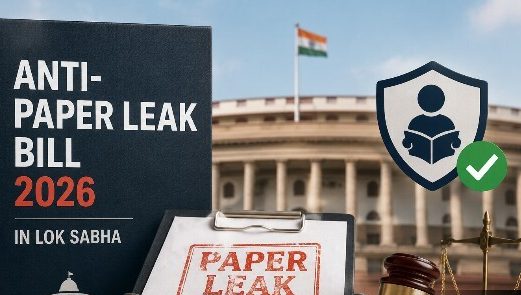
Lok Sabha passes Anti-Paper Leak Bill 2026 with stricter punishments, higher fines and fast-track trials to curb examination fraud in India.
The Lok Sabha on Wednesday passed the Public Examination (Prevention of Unfair Means) Amendment Bill, 2026, aimed at strengthening action against paper leaks and unfair practices in government and public examinations. The bill was cleared after a detailed discussion that continued for nearly two days in the House.
The legislation proposes tougher punishments, higher fines, faster investigations, and stricter action against individuals, service providers, and organised groups involved in examination-related crimes.
Harsher Punishment for Paper Leak Offences
Under the proposed amendments, individuals involved in unfair means during public examinations may face imprisonment of a minimum of five years, which can be extended up to ten years. The existing punishment was a minimum of three years and a maximum of five years.
The maximum financial penalty has also been increased from ₹10 lakh to ₹50 lakh to create a stronger deterrent against examination fraud.
Strict Action Against Service Providers
The amendment bill also introduces stricter provisions for service providers found involved in paper leaks or examination-related violations.
Such entities may face a fine of up to ₹5 crore. Additionally, their ban from conducting public examinations has been increased from four years to eight years.
For organised examination crimes, the minimum imprisonment has been proposed to increase from five years to seven years, with the punishment extendable up to ten years. The maximum fine for such offences will rise from ₹1 crore to ₹10 crore.
Special Task Force and Fast-Track Trials
The new bill empowers the central government to establish a Special Task Force to investigate paper leaks and other examination-related offences.
It also proposes a dedicated timeline for legal proceedings:
Investigation to be completed within two months
Special Fast Track Courts for daily hearings
Trial completion within three months after filing of the charge sheet
Appointment of Special Public Prosecutors for these courts
The government said these measures will ensure quick justice for students affected by examination irregularities.
also read:- Cockroach Janta Party: From A Judge’s Remark To A Minister’s Resignation
Jitendra Singh Targets Opposition During Debate
While responding to the debate, Union Minister Jitendra Singh criticised Congress leader and Leader of Opposition Rahul Gandhi over his remarks during the discussion.
Singh accused Gandhi of using unparliamentary language and questioned whether he was aware of basic parliamentary practices. He also said that discussions on important legislation should focus on solutions rather than political arguments.
The minister further addressed allegations related to police action during protests in Delhi, stating that no firing took place and that only tear gas was used. He clarified that decisions regarding such actions are taken by magistrates and not ministers.
Rahul Gandhi Raises Concerns Over Education System
During the debate, Rahul Gandhi criticised the government’s handling of the education system and alleged that students were facing restrictions in expressing their views and choosing their career paths.
He also raised concerns over the NEET-UG 2026 paper leak protests, saying that students were expressing frustration over issues affecting their future and that their voices should be heard.
Gandhi demanded accountability from the government and questioned the functioning of the education system.
Debate Witnesses Heated Exchange
The discussion on the bill witnessed strong arguments between opposition leaders and treasury bench members. Parliamentary Affairs Minister Kiren Rijiju objected to certain remarks made during the debate, while Lok Sabha Speaker Om Birla reminded members to maintain parliamentary decorum.
Despite political disagreements, the bill was eventually passed by the lower house with the government highlighting it as an important step towards protecting the future of students and ensuring transparency in examinations.
Government’s Focus on Exam Transparency
The passage of the Public Examination (Prevention of Unfair Means) Amendment Bill, 2026 marks a major move by the government to tackle paper leaks and organised examination fraud.
With stricter punishments and faster legal processes, the Centre aims to restore confidence among students appearing for competitive and public examinations across the country.
For More Hindi News: http://newz24india.com