
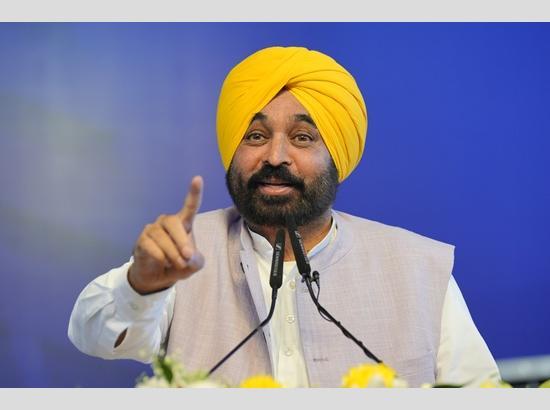
Punjab Industrial Policy 2026 targets 32% GSVA contribution by 2030, 10 new industrial parks, 1,000 startups and growth in high-tech manufacturing.
Marking a decisive shift from its traditional agrarian baseline toward high-value technology and advanced manufacturing, the Government of Punjab has rolled out its comprehensive Industrial and Business Development Policy 2026. The policy sets an ambitious
developmental roadmap aimed at repositioning the border state as one of India’s most competitive, sustainable, and investor-friendly industrial ecosystems.
At the center of this economic blueprint is a targeted commitment: elevating the secondary sector’s share in Punjab’s Gross State Value Added (GSVA) from 27% to 32% by 2030. Backed by rapid regulatory clearances, an energy-surplus power grid, and major infrastructure upgrades, the policy seeks to accelerate capital inflows, foster deep-tech entrepreneurship, and generate high-skill employment across all 23 districts.
Economic Engine: From Agrarian Pioneer to Industrial Hub
Occupying 50,362 square kilometers with an estimated population surpassing 3.0 crore, Punjab constitutes 1.5% of India’s landmass while contributing 2.5% to the national Gross Domestic Product (GDP). In the 2023–24 fiscal year, the state’s Gross State Domestic Product (GSDP) reached approximately USD 89.33 billion.
Historically celebrated as India’s breadbasket, Punjab has steadily built an expansive manufacturing and export base. Today, the state commands a dominant presence in several core industrial segments:
· Bicycle & Mobility Ecosystem: Accounts for nearly 75% of India’s bicycle production and 92% of bicycle component manufacturing, housing industry leaders like Hero Lectro, Avon Cycles, TI Tubes, and Ralson Tyres.
· Textiles & Technical Garments: Produces 65% of the country’s hosiery output and 95% of its woollen manufacturing, driven by conglomerates such as Trident Ltd, Vardhman Textiles, Monte Carlo, and Nahar Spinning Mills.
· Light Engineering & Tractors: Anchored by the world’s largest tractor manufacturing facility alongside brands like Swaraj Mahindra, International Tractors Limited (Sonalika), John Deere, and CLAAS.
· Sports Goods & Fitness Equipment: Emerging as an export-oriented precision manufacturing cluster, led by manufacturers such as Nivia and Tynor.
The 2026 policy builds upon this legacy, driving traditional manufacturing clusters toward value addition—such as premium technical textiles, precision auto components, and advanced fitness equipment—while building next-generation capacity in clean mobility, semiconductors, and digital services.
Key Policy Targets by 2030
The policy establishes clear quantitative milestones to measure industrial progress over the next decade:
1. Secondary Sector Expansion: Increase manufacturing and secondary sector contribution to 32% of GSVA by 2030.
2. Industrial Park Development: Build 10 new modern industrial parks to expand the existing industrial footprint, which currently includes 52 focal points and 1,974.53 hectares of industrial land.
3. Startup Incubation: Incubate over 1,000 innovative startups and construct 10 state-of-the-art incubation centres, partnering with elite academic institutions like IIT Ropar and IIM Amritsar.
4. Targeted Regional Growth: Channel targeted capital and incentives into the ecologically sensitive Kandi region and remote border areas to ensure equitable economic distribution.
also read:- Punjab Targets 10 New Industrial Parks, 1,000 Startups…
Aggressive Ease of Doing Business (EoDB) Reforms
To cut bureaucratic bottlenecks, the policy expands the operational scope of the Invest Punjab Business First Portal, which previously earned the state the national Digital India Silver Award. Following Punjab’s top-tier ranking in the DPIIT Ease of Doing Business evaluation, the new framework codifies firm statutory timelines:
· In-Principle Approvals in 5 Days: Under the Punjab Right to Business Act, eligible projects with capital investments up to ₹125 crore receive in-principle clearance based on self-declaration within five working days.
· Digital Clearances within 45 Days: A unified platform integrating over 120 clearances across 20+ state departments enforces automatic deemed-approval mechanisms within 45 working days.
· 15-Day Revenue Feasibility: Digital Revenue Feasibility Certificates must be processed and issued within 15 working days.
· Fast-Track Incentives: A modernized Digital Incentive Disbursal System eliminates administrative delays in releasing fiscal subsidies.
· Operations & Maintenance Act: The government plans to notify a dedicated act enabling direct private sector participation in maintaining and operating industrial focal points.
Infrastructure, Power, and Multi-Modal Logistics
Punjab’s logistical connectivity remains one of its most attractive assets for supply-chain planners. The state features one of the highest rail and road network densities in India, incorporating:
· A 1,47,862 km road network and 2,265 km rail network.
· Two operational international airports (Amritsar and Mohali) and four domestic airports (Ludhiana, Jalandhar, Bathinda, and Pathankot).
· Three Multi-Modal Logistics Parks (MMLPs), five Inland Container Depots (ICDs), eight Container Freight Stations (CFSs), 78 Railway Goods Sheds, and three Integrated Check Posts.
· Massive warehousing and cold chain infrastructure, offering 5.5 million metric tonnes (MMT) of warehousing and 2.35 MMT of cold storage capacity.
Energy availability serves as another pillar of competitiveness. With an installed capacity of 14,747 MW (as of 2023–24), Punjab operates as an energy-surplus state. Approximately 33% of its power is drawn from hydro and renewable sources, paired with a resilient distribution grid featuring 66 KVA substations every 10 kilometers and a 400 KVA ring network. The state government reiterated its commitment to providing power at rationalized, competitive industrial tariffs, keeping operational overhead well below that of neighboring northern states.
Mohali: The Emerging Deep-Tech & Semiconductor Hub
Recognizing the shift toward knowledge economies, the 2026 policy positions Mohali as northern India’s hub for Information Technology, Electronics System Design & Manufacturing (ESDM), Artificial Intelligence, and Semiconductors.
The state is capitalizing on the presence of premier research entities—including the Semiconductor Laboratory (SCL), Indian Institute of Science Education and Research (IISER Mohali), Institute of Nano Science & Technology (INST), and the Indian School of Business (ISB Mohali). Key strategic projects underway include:
· The 1,000-acre Integrated Manufacturing Cluster at Rajpura.
· The specialized Hi-Tech Cycle Valley in Ludhiana.
· The dedicated IT City in Mohali and Medicity in New Chandigarh.
These clusters will focus on emerging verticals: Artificial Intelligence, Robotics, AgriTech, CleanTech, Electric Mobility, and Global Capability Centres (GCCs).
Competitive Human Capital and Labor Stability
Punjab’s demographic profile provides a young, ready industrial workforce, with nearly 70% of the state’s population falling in the working-age bracket (15–59 years).
To maximize operational efficiency for manufacturing units, the state maintains a flexible labor framework permitting 24/7 industrial operations across multiple shifts, supported by a long-standing environment of industrial harmony marked by the absence of strikes and lockouts. In parallel, the policy mandates industry-aligned vocational curriculums and skilling tie-ups with institutions such as IIT Ropar and technical universities to prepare workers for automated and high-precision production environments.
Supported by healthcare hubs like AIIMS Bathinda, DMC Ludhiana, and Fortis Mohali, alongside premier educational ecosystems, Punjab presents an integrated environment suited for sustainable corporate relocation.
With the Industrial and Business Development Policy 2026, Punjab lays down a clear, market-oriented growth framework. By synchronizing digital governance, infrastructure development, and sector-specific industrial clusters, the state makes a compelling case to global and domestic boardrooms evaluating long-term expansion in India.
For More Hindi News: http://newz24india.com