
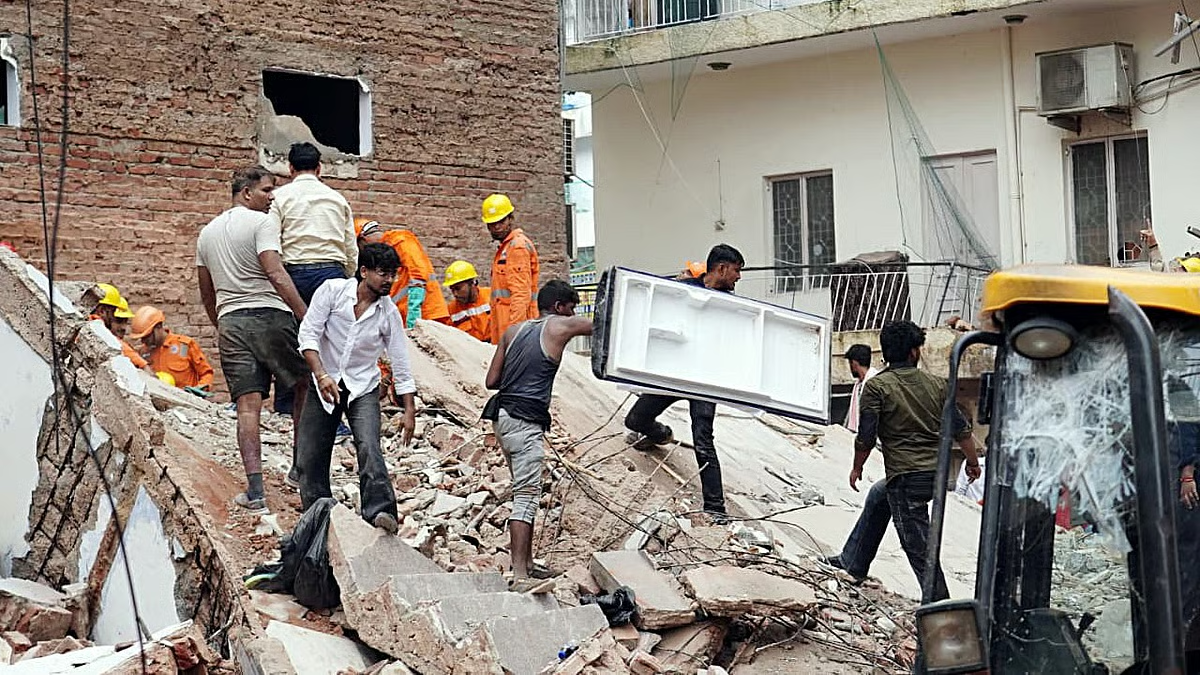
Delhi plans a new PG Safety Policy after the Satya Niketan tragedy, with structural audits proposed for old buildings used as PGs.
The Delhi government is preparing a new PG Safety Policy aimed at improving the safety and regulation of paying guest accommodations across the national capital following the Satya Niketan building collapse.
Chief Minister Rekha Gupta said on Monday that the proposed policy would require owners of older buildings to submit structural audit reports before using their properties as PG accommodations, nursing homes, schools or other commercial establishments. Buildings would also have to meet the required safety standards before being allowed to continue such use.
The move comes after a building near Delhi University’s South Campus in Satya Niketan, which was being used for PG accommodation, collapsed. The incident has once again brought the safety of student housing and the regulation of PG facilities into focus.
PG Regulation Efforts Date Back to 1993
While the proposed PG Safety Policy has emerged in the wake of the recent tragedy, efforts to regulate paying guest accommodations in Delhi have been underway for more than three decades.
A 2006 Delhi High Court judgment referred to the Central government’s Paying Guest Accommodation Scheme, which was introduced in Delhi in 1993. The original scheme was designed primarily to provide tourists with affordable and clean accommodation in residential properties.
One of its key conditions was that the homeowner should also reside in the same building. The scheme allowed a limited portion of a house to be used for paying guests rather than permitting large-scale commercial PG operations.
Delhi Introduced Its Own Scheme in 2000
The regulation of the PG Safety Policy scheme was subsequently taken up by the Delhi government. In 2000, the then Delhi government approved its own Paying Guest Accommodation Scheme.
Under the scheme, homeowners could register with the Delhi Tourism Department to accommodate paying guests. Restrictions were also placed on the number of rooms and beds that could be used for this purpose.
However, the nature of PG accommodation in Delhi changed significantly over the years. Large commercial PGs and private hostels began expanding around universities, coaching centres and employment hubs, particularly in areas frequented by students.
Growing PG Sector Exposed Regulatory Gaps
As the PG industry expanded, questions surrounding its regulatory framework became increasingly important. The existing arrangements were largely designed for homeowners accommodating a limited number of guests and did not adequately address the growth of large-scale commercial PG establishments.
A Delhi Assembly petition committee examining problems faced by students around Delhi University had also raised questions about the rules governing PG accommodations and which agencies were responsible for enforcing them.
In a meeting held in August 2019, the committee asked officials to prepare a list of PG accommodations and other establishments operating around Delhi University. It also sought a clear document outlining the applicable rules and identifying regulatory gaps related to fire safety, building standards and health licences.
According to the committee’s report, the requested document had not been received at that stage.
also read:- AAP Student Wing ASAP Holds Candle March For Students…
More Surveys and Regulation Proposals Followed
The issue remained under discussion in subsequent years. In 2021, the then North Delhi Municipal Corporation proposed conducting a survey of PG accommodations, particularly those operating around Delhi University’s North Campus. It also proposed registering buildings being used for commercial purposes.
In 2022, discussions between the Delhi government’s Home Department, police and civic agencies led to a proposal to bring around 700 private hostels and PG accommodations used by college students under a licensing framework.
The proposed regulatory framework included issues such as occupancy limits, kitchens, lifts, fire safety clearances and other essential facilities. Officials had also acknowledged the absence of a specific statutory authority for regulating such establishments.
Mukherjee Nagar Fire Renewed Safety Concerns
The safety of PG accommodations again came under scrutiny after a fire at a women’s PG facility in Mukherjee Nagar in September 2023. Following the incident, the Municipal Corporation of Delhi ordered another survey of PG establishments.
At the time, civic officials said there were no specific rules governing the operation of PG accommodations in residential areas, although regulations relating to building construction, land use and fire safety continued to apply.
The subsequent survey identified more than 100 PG accommodations that were allegedly operating in violation of building-related regulations.
New Policy May Focus on Structural Safety
The latest proposal for a PG Safety Policy comes against this long-running background of regulatory challenges. The planned framework is expected to place greater emphasis on the structural condition of buildings being used to accommodate students and other residents.
Under the proposed approach, owners of older properties may have to obtain structural audit reports and demonstrate that their buildings are safe before using them for PG accommodation or other specified commercial purposes.
The PG Safety Policy could therefore address not only PG operations but also the broader question of whether older buildings are structurally suitable for accommodating large numbers of people.
The Satya Niketan incident has once again highlighted the need for clear rules, effective inspections and accountability among agencies responsible for building and fire safety.
As Delhi prepares the new PG Safety Policy, the key challenge will be ensuring that regulations are clearly defined and consistently enforced across the city, particularly in areas where large numbers of students depend on private PGs and hostels for accommodation.
For More Hindi News: http://newz24india.com