
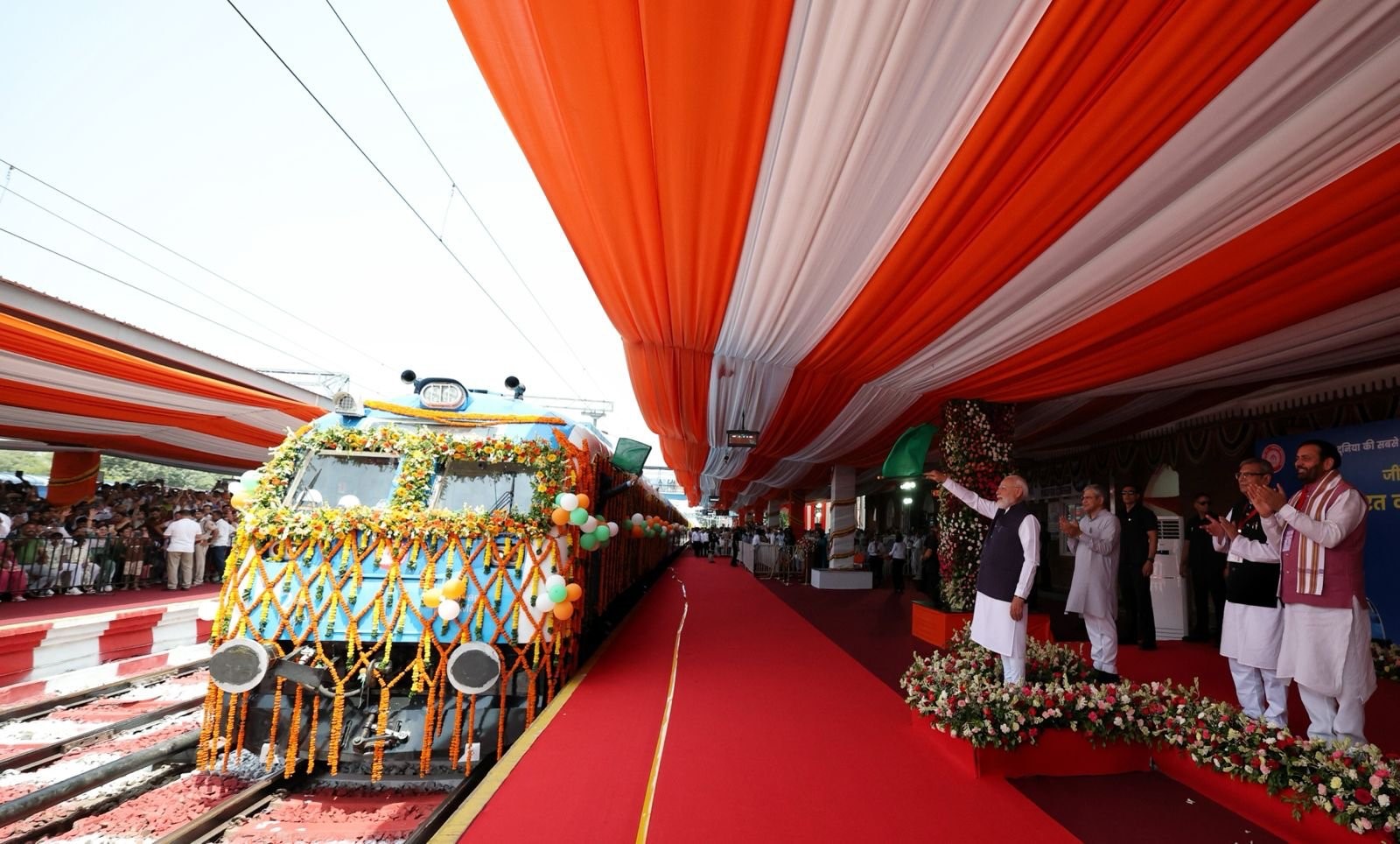
PM Narendra Modi inaugurated ₹14,700 crore development projects in Haryana and flagged off India’s first hydrogen-powered train from Jind.
Prime Minister Narendra Modi on Friday launched and laid the foundation stone for development projects worth approximately ₹14,700 crore in Haryana during a public event at Eklavya Stadium, Jind. The ceremony was attended by Haryana Chief Minister Nayab Singh Saini, Union Railway Minister Ashwini Vaishnaw, and other senior leaders.
The projects span road infrastructure, healthcare, railways and cultural heritage, with the government highlighting them as key initiatives to improve connectivity, strengthen public services and support economic growth across the state.
Major Highway Projects Worth Over ₹12,470 Crore
A significant portion of the investment is dedicated to expanding Haryana’s road network. Prime Minister Modi inaugurated and laid the foundation stone for National Highway projects valued at more than ₹12,470 crore.
Among the flagship projects is the 157.92-km Delhi–Amritsar–Katra Expressway (Packages 1–5), developed at an estimated cost of ₹9,680 crore. Once fully operational, the expressway is expected to reduce travel time from Delhi to Katra from nearly 14 hours to around 6 hours, while the Delhi-Amritsar journey will be shortened from about 8 hours to nearly 4 hours.
The expressway is also expected to ease congestion on NH-44 (GT Road), improve access for pilgrims travelling to Shri Mata Vaishno Devi, and create new opportunities for industrial and logistics development along the route.
New Highways to Improve Regional Connectivity
The Prime Minister Narendra Modi also dedicated the 33.81-km Ambala–Kala Amb four-lane highway, which is expected to strengthen transport links between Haryana and Himachal Pradesh while benefiting industries located in the Kala Amb industrial region.
Another important project inaugurated was the 40.60-km Jind–Gohana Greenfield Highway on NH-352A. The new highway is expected to reduce travel time between Jind and Gohana from nearly two hours to about 40 minutes, providing faster connectivity to Rohtak, Panipat and the Delhi-NCR region.
Additionally, the foundation stone was laid for the 24.27-km Hansi–Barwala Brownfield Highway, which will upgrade the existing road into a wider two- and four-lane corridor.
Boost to Healthcare and Urban Infrastructure
Prime Minister Narendra Modi dedicated the elevated railway track at Kurukshetra, a project designed to eliminate traffic congestion caused by railway crossings and improve road safety.
He also inaugurated two major healthcare institutions:
Pandit Neki Ram Sharma Government Medical College, Bhiwani
Maharishi Chyawan Medical College and Rao Tula Ram Hospital, Koriawas (Narnaul)
These institutions are expected to increase MBBS seats, strengthen medical education, improve specialist healthcare services and enhance Haryana’s overall healthcare infrastructure.
also read:- President Murmu Launches Saushrutam 2026 At AIIA,…
Foundation Stone for Sikh Museum
As part of efforts to preserve India’s cultural heritage, the Prime Minister laid the foundation stone for the Sikh Museum in Kurukshetra.
The museum will showcase the history of Sikhism, the teachings of Sikh Gurus, their sacrifices, and the contribution of the Sikh community to India’s culture and civilization using modern digital technology.
India’s First Hydrogen-Powered Train Flagged Off
Earlier in the day, Prime Minister Modi flagged off India’s first hydrogen-powered passenger train between Jind and Sonipat, marking a major milestone in the country’s clean transportation mission.
The train has been designed and developed in India using indigenous technology and places the country among a select group of nations operating hydrogen-powered passenger rail services.
Powered by hydrogen fuel cell technology, the train generates electricity onboard by converting hydrogen into energy, producing only water vapour as a by-product and resulting in zero carbon emissions during operation.
Longest and Most Powerful Hydrogen Train
The newly launched train features a 10-coach configuration, making it one of the longest hydrogen-powered passenger trains in the world. Equipped with a 3,200 HP propulsion system, it is also among the most powerful hydrogen-powered trainsets currently in service.
Unlike conventional electric trains, the hydrogen-powered train does not require continuous overhead electrification, making it suitable for routes where electrification is limited while significantly reducing dependence on fossil fuels.