
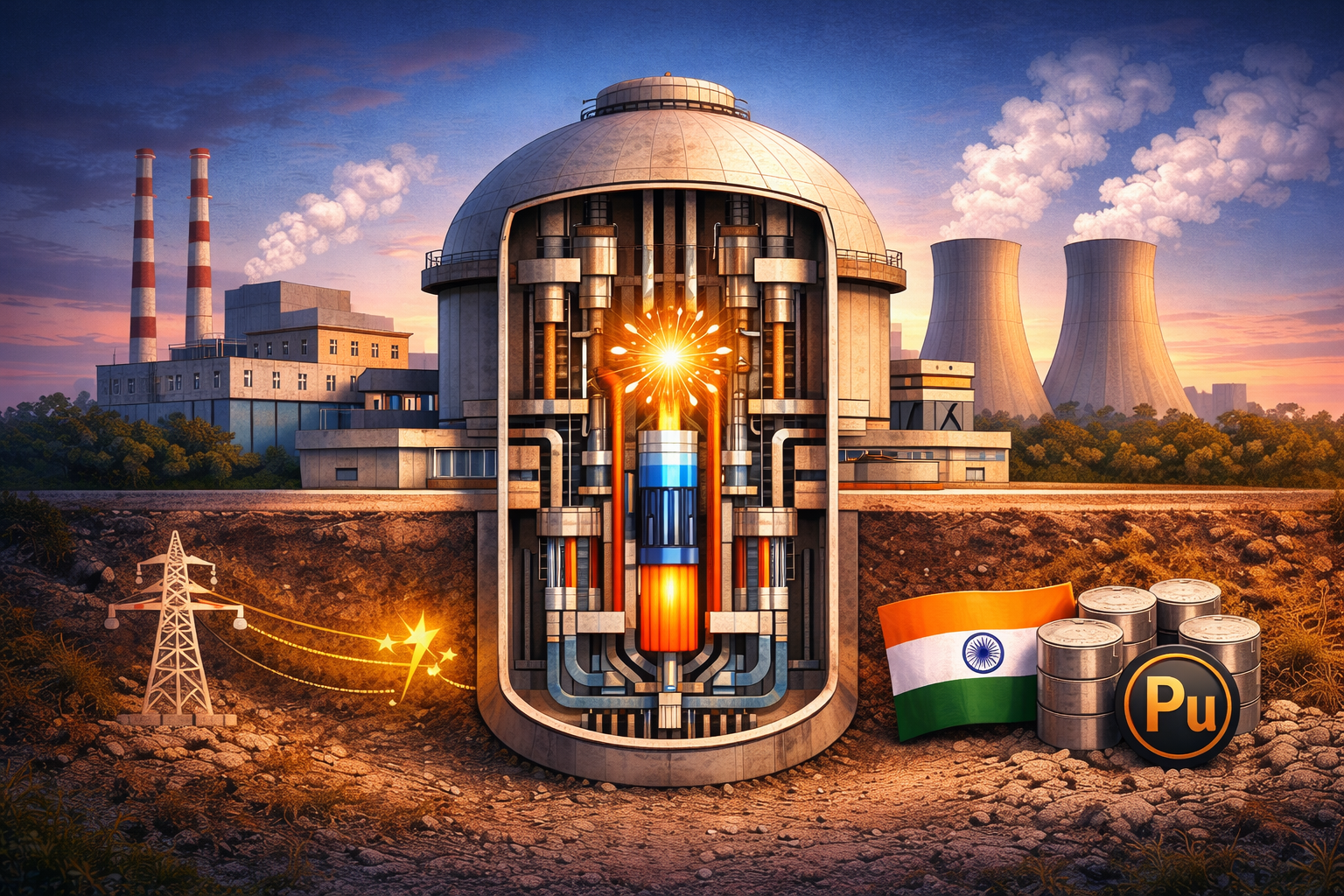
India has officially marked a historic turning point in its quest for energy independence. The Prototype Fast Breeder Reactor (PFBR) at Kalpakkam, Tamil Nadu, has achieved first criticality, signaling the start of a new era for the nation’s three-stage nuclear power programme.
Prime Minister Narendra Modi hailed the achievement as a “defining step,” moving India closer to utilizing its vast thorium reserves. Here are five essential things you need to know about this breakthrough.
also read: Microsoft HR Head Announces Restructuring for AI
1. What is a Fast Breeder Reactor (FBR)?
Unlike conventional thermal reactors, a Fast Breeder Reactor is designed to produce more fissile material than it consumes. While generating electricity, it “breeds” new fuel from fertile material.
Fast Neutrons: It uses high-energy (fast) neutrons to sustain the fission chain reaction.
Efficiency: This technology significantly maximizes the energy extracted from uranium, making it far more sustainable than traditional reactors.
2. Understanding “First Criticality”
In nuclear science, criticality is the “ignition” point of a reactor. It is the state where a nuclear chain reaction becomes self-sustaining.
The Balance: At this stage, the number of neutrons produced by fission exactly equals the number of neutrons lost or absorbed.
The Milestone: Achieving first criticality provides the operational validation and safety clearance required to begin steady power production and transition to future stages.
3. PFBR Technical Overview: Fuel and Cooling
Developed by the Indira Gandhi Centre for Atomic Research (IGCAR), the PFBR is a marvel of indigenous engineering.
Fuel Source: It utilizes a Uranium-Plutonium Mixed Oxide (MOX) fuel.
Cooling System: The reactor uses liquid sodium as a coolant. Liquid sodium allows the reactor to operate at high temperatures and low pressure, which enhances thermal efficiency.
Closed Fuel Cycle: The PFBR is part of a “closed” cycle, meaning spent fuel is reprocessed and recycled back into the reactor, minimizing nuclear waste.
4. India’s Growing Nuclear Energy Landscape
Nuclear energy is becoming a pillar of India’s power grid. Currently, the country generates 8.78 GW of nuclear power, accounting for roughly 3.1% of total electricity generation.
Current Output: In the last year, indigenous plants generated 56,681 million units of electricity.
2032 Projection: With several 700 MW and 1,000 MW reactors currently under construction, the total capacity is expected to jump to 22.38 GW by 2032.
5. The Long-Term Mission: 100 GW by 2047
The Indian government has set an ambitious target of reaching 100 GW of nuclear capacity by 2047. To achieve this, the Union Budget 2025-26 introduced the Nuclear Energy Mission.
SMR Development: The mission has allocated ₹20,000 crore specifically for the design and deployment of Small Modular Reactors (SMRs).
The Roadmap: At least five SMRs are expected to be operational by 2033, providing a flexible and scalable solution to meet the nation’s rising energy demands.
For More Hindi News: http://newz24india.com