
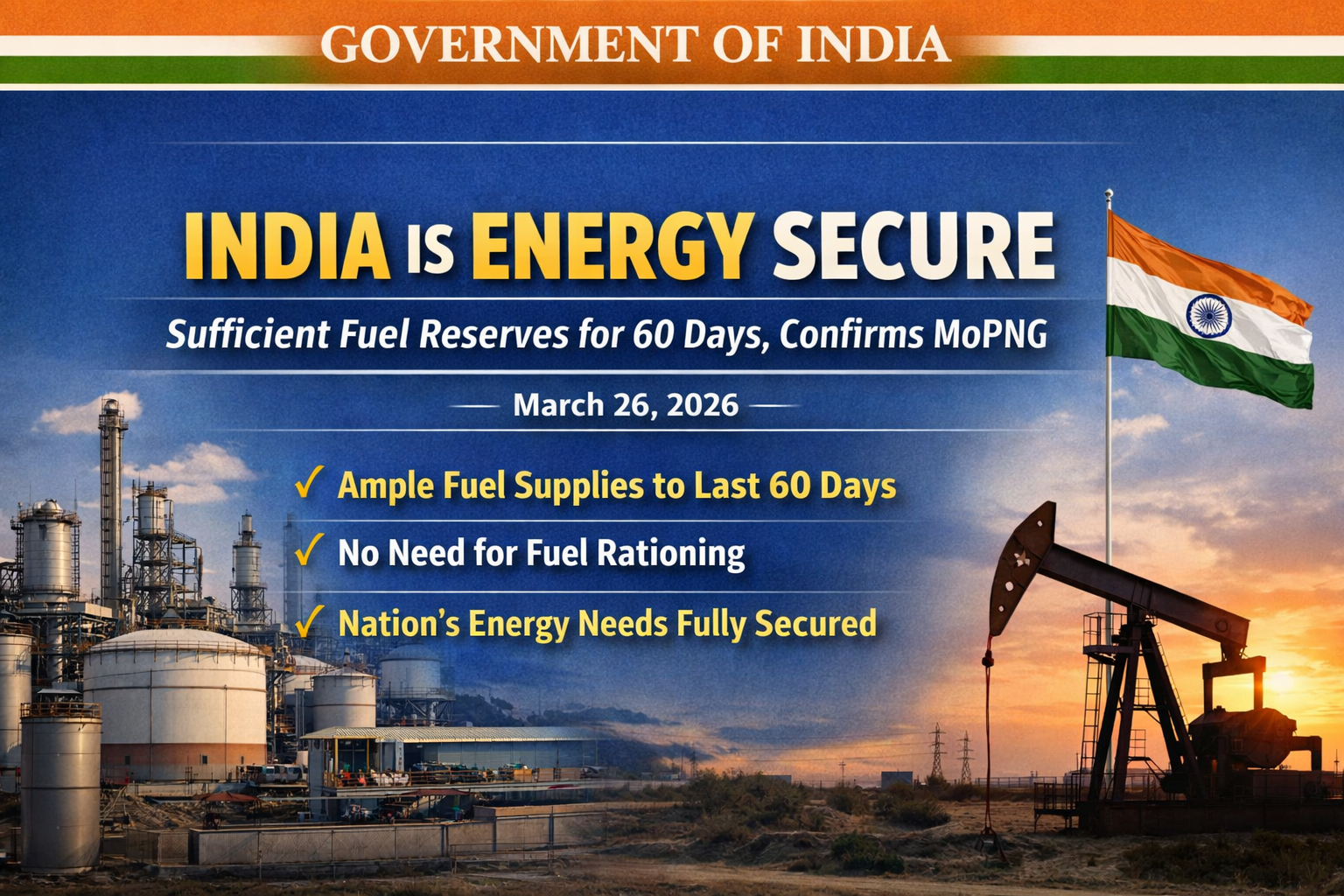
In a decisive move to quell public anxiety and stabilize the domestic market, the Government of India has officially declared the nation “energy secure” for the foreseeable future. Following a comprehensive review of the current geopolitical landscape, the Ministry of Petroleum and Natural Gas (MoPNG) confirmed on March 26, 2026, that the country possesses sufficient crude oil and finished fuel supplies to last for at least 60 days.
announcement serves as a direct rebuttal to growing rumors of potential fuel rationing and shortages triggered by escalating volatility in West Asia. By providing a clear, transparent window into the nation’s reserves, the government aims to prevent panic buying and maintain economic equilibrium.
A Proactive Shield Against Volatility
The cornerstone of this security lies in the proactive strategy adopted by India’s Oil Marketing
Companies (OMCs). Recognizing the fragility of global supply chains in the face of international conflict, tese entities have successfully “tied up” imports well in advance.
According to the official release by the Press Information Bureau (PIB), the 60-day buffer is not merely a theoretical figure but a combination of:
Operational Stocks: Fuel currently held in the tanks of refineries and storage depots across the country.
Strategic Reserves: Emergency stockpiles maintained by the Indian Strategic Petroleum Reserves Limited (ISPRL).
Contracted Imports: Crude shipments that are already on the water or have guaranteed delivery schedules through pre-signed agreements.
This “no supply gap” guarantee is designed to reassure industries, transport sectors, and everyday commuters that the pumps will remain operational, regardless of the headlines coming out of the Middle East.
Silencing the Rumor Mill
The government’s communication was uncharacteristically blunt regarding the spread of misinformation. Officials urged the public to ignore speculative social media reports suggesting that petrol pumps would soon run dry.
“The country’s energy situation remains stable and fully under control,” a ministry official stated. “There is no cause for alarm. Our supply lines are diversified, and our domestic stocks are robust.”
By explicitly stating a two-month safety net, the government is providing a psychological buffer. Even in a worst-case scenario where global supplies were momentarily interrupted, India has the breathing room to negotiate new trade routes or adjust its internal consumption patterns without immediate disruption.
The Broader Strategic Context
India is the world’s third-largest consumer of crude oil, importing approximately 85% of its requirements. This heavy dependence makes the Indian economy particularly sensitive to price spikes and supply chain bottlenecks in West Asia.
However, the 2026 energy security strategy highlights a more resilient India. Over the last several years, the government has focused on:
Supplier Diversification: Moving beyond traditional sources to include a wider array of global partners.
Increased Storage Infrastructure: Expanding the capacity of underground salt caverns and tanks to hold larger volumes of “ready-to-use” oil.
Refinery Efficiency: Ensuring that domestic refineries are operating at peak capacity to convert crude into petrol, diesel, and aviation fuel without delay.
Looking Ahead
While the 60-day assurance provides immediate relief, the Ministry of Petroleum and Natural Gas continues to monitor the situation daily. The government remains in constant dialogue with international energy agencies and oil-producing nations to ensure that the “60-day” window is maintained as a rolling average, consistently replenished as stocks are consumed.
For the average citizen, the message is clear: Carry on as usual. The tankers are moving, the refineries are humming, and the nation’s energy pulse remains steady.