
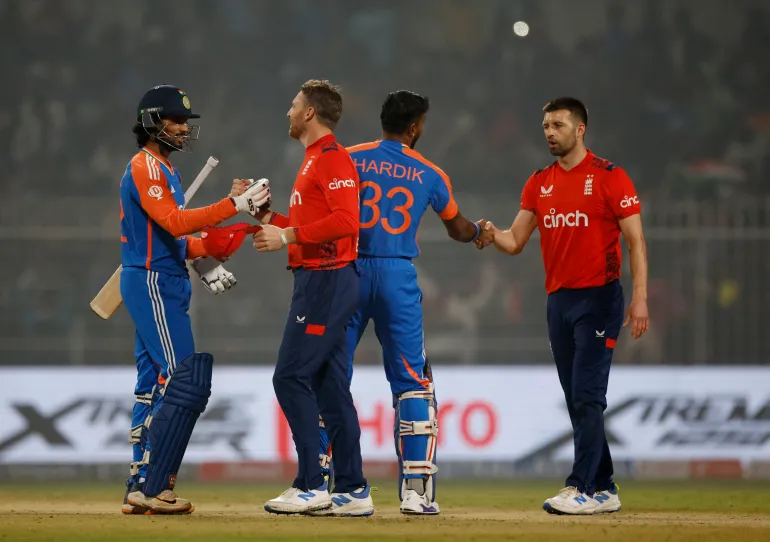
India vs England : During their last tour of England, India had the upper hand for most of the series. The tour was held in two parts, with India leading 2–1 after four Tests when a Covid-19 outbreak in the squad and support staff caused the final Test to be postponed indefinitely. That decider was eventually played ten months later, where England pulled off a stunning chase of 378 runs in the fourth innings.
The Rain Factor
India may well have clinched the series if not for rain interrupting the first Test at Trent Bridge. With Jasprit Bumrah claiming nine wickets in the match, India were in a strong position, needing just 209 to win in the final innings. They had reached 52 for 1 by the end of Day 4, with Rohit Sharma and Cheteshwar Pujara looking settled and composed.
The pitch had become more batter-friendly as the match progressed, with each team posting higher scores in successive innings. India were clearly in control, but persistent rain on Day 5 meant no further play was possible.
The Victories
At Lord’s, England had edged ahead with a slender 37-run lead in the first innings. Tensions rose after Bumrah bowled a few bouncers at James Anderson, angering the English side. In response, England’s bowlers targeted Bumrah and Mohammed Shami with short balls, but it backfired. India recovered from 209/8 to 298/8 before Virat Kohli declared the innings.
The declaration came shortly after lunch, and Kohli famously challenged his bowlers to make England “feel hell” for 60 overs. The Indian pace attack — Bumrah, Shami, Siraj, and Ishant — responded brilliantly, dismissing England in just 51.5 overs to seal one of India’s most iconic Test victories.
Although India dominated large portions of the series, it ended in a 2–2 draw — a result that felt like a missed chance. A series win would have meant India simultaneously holding away Test series victories in both England and Australia. They later went on to draw 1–1 in South Africa as well. This unique combination would have been a historic first for an Indian team. However, England’s aggressive “Bazball” approach, powered by Jonny Bairstow’s back-to-back centuries, turned the tide and dashed India’s hopes.
London turned out to be a successful venue for India during that tour, with memorable wins at both Lord’s and The Oval. With the series level at 1–1, India took control in the fourth Test at The Oval, dominating the final two innings. Despite falling 99 runs short in the first innings, India mounted an impressive comeback by posting a massive 466 in their second innings. While the runs came from across the batting lineup, the innings was anchored by a brilliant 127 from Rohit Sharma. England started strong in their chase at 100 without loss, but India’s bowlers stepped up once again, triggering a collapse and bowling them out for just 210.
In the third Test at Headingley, India opted to bat first after winning the toss, but things quickly went south as they were bundled out for just 78. England’s fast bowlers delivered their most dominant session of the series. India’s misjudgment of the playing conditions left them in a deep hole they couldn’t recover from.
Matthew Hayden Backs India
Former Australian opener Matthew Hayden expressed confidence in India’s chances for a Test series win, stating, “I don’t think England’s bowlers are all that special.”
The More Painful Loss
India’s second defeat was arguably more painful. Centuries from Rishabh Pant and Ravindra Jadeja powered them to a strong total of 416. The bowlers then stepped up again, giving India a 132-run lead despite a century from Jonny Bairstow. Although they didn’t make as many as expected in the third innings, India still set England a target of 378 with five sessions left — a position from which they were expected to close out the match and series.
But then, England’s aggressive ‘Bazball’ approach turned the game on its head. Chasing the target in just 76.3 overs at a rate of nearly five runs per over, England stunned India. With Rohit Sharma sidelined due to Covid, Jasprit Bumrah captained the side for the first time — what looked like a dream debut turned into a tough reality.
Key Takeaways
India’s strength lay in their teamwork, both with the bat and the ball. While a few players delivered standout performances, it was the overall team effort that kept them in the contest. Success in away series often hinges on collective consistency rather than just individual brilliance.
The series also highlighted how devastating Bazball can be when it works. While it’s not always successful, when it does click, traditional Test match strategies may not be enough. India might need to adapt on the fly — using defensive fields, cutting off runs, and disrupting momentum when the opposition shifts into Bazball mode.
If India can fine-tune these two areas — collective effort and tactical flexibility — they still have a strong shot at achieving the series victory that narrowly slipped away last time.